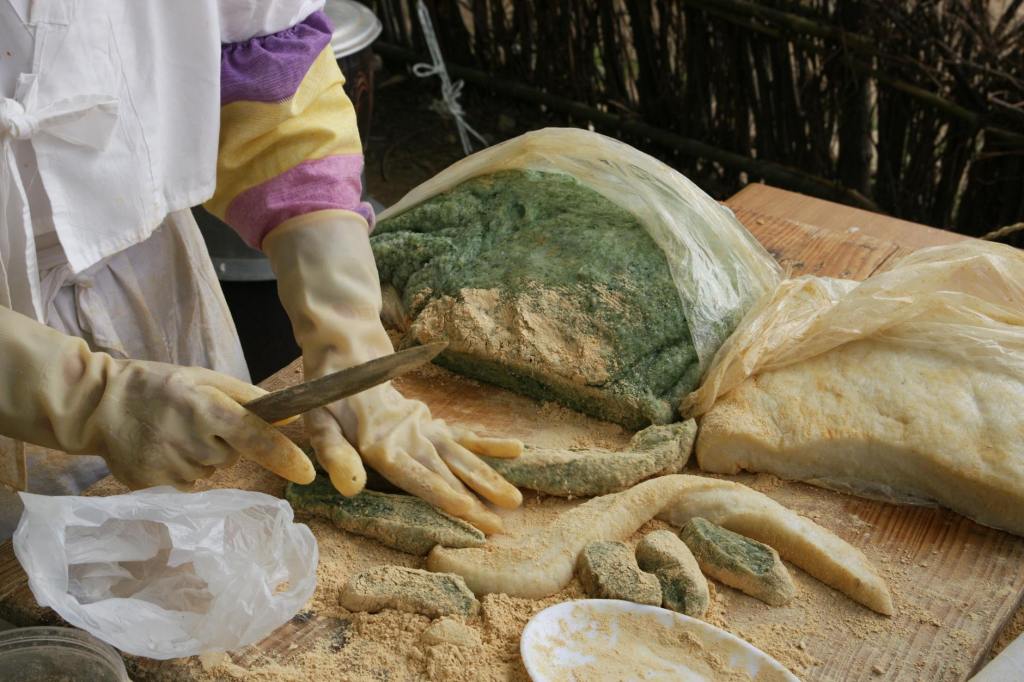
Korean rice cakes, known as tteok, are often associated with tradition, celebration, and casual snacking. But for many international readers, the practical question is simpler: how high in calories is tteok? That matters now because tteok is no longer seen only as a ceremonial or holiday food. It is also part of everyday snack culture, and newer products are sometimes marketed with health or diet-friendly language.
The first thing to understand is that there is no single calorie answer for “tteok.” Rice cakes vary a lot by ingredients, texture, fillings, and sweetness. A plain steamed rice cake and a chewy sweet rice cake filled with red bean paste do not carry the same nutritional weight, even if both are called tteok.
Why tteok calories vary so much
The main reason calorie counts differ is composition. Some rice cakes are relatively simple and rely mostly on rice flour and light seasoning. Others include sticky rice, sweet fillings, coatings, oils, nuts, or cream-based additions. That is why the category can feel deceptively uniform from the outside while being quite different in calorie density from one type to another.
Tteok is not one food in nutritional terms. It is a broad family of rice cakes, and the calories depend heavily on what has been added to the rice base.
What the research summary suggests
The research summary gives a few specific examples that are useful as rough reference points. One source states that, per 100 grams, injeolmi is about 170 kcal, garaetteok about 239 kcal, and chapssaltteok about 280 kcal. Another source in the summary says jeungpyeon, a fermented rice cake sometimes called sultteok, tends to be one of the lighter options mentioned.
These figures should be read carefully. They are useful for comparison, but portion size matters just as much as the number itself. A small serving of a higher-calorie tteok may still be lighter than a large serving of a lower-calorie one.
- Lighter in the summary: jeungpyeon is described as relatively low in calories
- Moderate example: injeolmi is cited at about 170 kcal per 100g
- Higher examples: garaetteok and chapssaltteok are cited at higher levels per 100g
- Added ingredients matter: fillings, coatings, cream, or sweet toppings can push calories up further
Traditional tteok and newer variations are not the same thing
Another useful point from the research summary is that not all Korean rice-cake products are traditional in a narrow sense. The summary mentions newer variations such as cream-filled rice cakes and even lower-calorie or modified versions of hotteok, a Korean filled pancake often discussed alongside snack culture. That matters because modern dessert-style products can be much richer than the simpler rice cakes many people imagine when they hear the word tteok.
For international readers, this means it is better to think in categories. Plain, steamed, or lightly sweetened rice cakes are one thing. Filled, coated, dessert-style, or cream-based products are another.
How to think about calories in a realistic way
It is easy to overreact to calorie numbers, but the better approach is proportion. The research summary notes typical daily calorie guidance of around 2,400 kcal for adult men and 2,000 kcal for adult women. That does not turn tteok into a “good” or “bad” food by itself. It simply means sweet and dense rice cakes can add up quickly if eaten casually as snacks.
So the practical takeaway is straightforward: if you want a lighter choice, look for simpler tteok with fewer added ingredients and be mindful of portion size. If you are choosing filled or dessert-style rice cakes, it makes sense to treat them more like a substantial snack than a negligible one.
Conclusion
Korean rice cakes are not automatically low-calorie just because they look small or traditional. Some are relatively light, while others are dense and filling. The best way to judge tteok is by type, ingredients, and portion size. For international readers exploring Korean food, that is the most useful way to understand both the appeal and the calorie question.
Photo by FREE VIDEO HAPPY on Pexels


 Trend Kr
Leave a comment