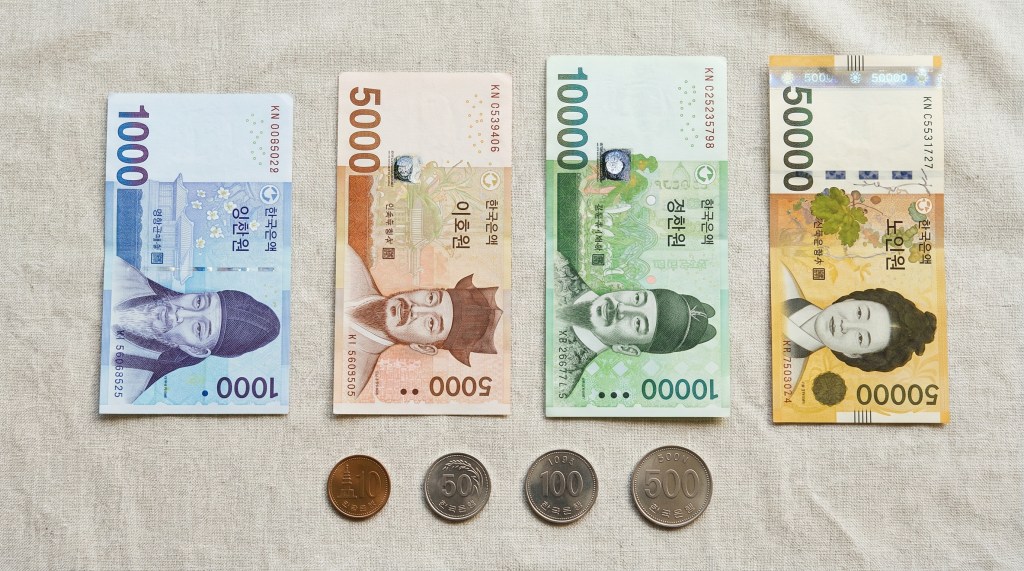
South Korea’s currency system is straightforward, but daily payment habits are changing fast. The country uses the won as its currency, and both banknotes and coins remain in circulation. But for international travelers, the practical reality is simple: you may see Korean cash often, yet you are likely to use cards much more than coins in everyday life.
This matters now because Korea has become a highly card-friendly and mobile-payment-friendly society. Recent reporting in the research summary notes that coin use has declined as credit cards and smartphone payments have become more common. So the best way to understand Korean money is not only by learning the denominations, but by knowing which ones still matter most in practice.
The basic unit: the Korean won
South Korea’s currency is the Korean won (KRW). In everyday writing, prices are usually shown with the symbol ₩ or simply written as a number followed by “won.” For travelers, the important point is that Korea’s currency system is decimal and easy to read once you recognize the standard denominations.
In Korea, understanding cash is useful, but understanding how little cash you may need is just as useful.
Korean banknotes and coins
According to the research summary, Korean money is commonly described as consisting of 4 banknotes and 6 coins, although the smallest coins are now rarely used in ordinary life.
- Banknotes: 1,000 won, 5,000 won, 10,000 won, 50,000 won
- Coins: 1 won, 5 won, 10 won, 50 won, 100 won, 500 won
For practical travel purposes, however, not all of these matter equally. The 1 won and 5 won coins are so rarely used in normal daily transactions that most visitors are unlikely to handle them. In real-life spending, the denominations travelers are more likely to encounter are 10 won, 50 won, 100 won, and 500 won among coins, and the four main banknotes among paper currency.
Which denominations are most useful for travelers?
If your goal is practicality rather than completeness, the most useful Korean cash denominations are usually:
- 1,000 won note: useful for small purchases and low-cost items
- 5,000 won note: common and convenient for ordinary everyday spending
- 10,000 won note: one of the most practical bills for visitors
- 50,000 won note: useful for larger payments, though sometimes less convenient for very small purchases
- 100 won and 500 won coins: the coin values travelers are most likely to notice in actual use
In other words, travelers do not need to study the full currency system in detail. In most practical situations, being comfortable with the four banknotes and the larger coin values is enough.
Why coins matter less than before
One of the clearest trends in the research summary is the declining use of coins. Reports note that the Bank of Korea has at times recovered more coins than it issued, and that annual coin issuance has fallen sharply as card payments and mobile payments have spread. That is a strong sign that small cash use is becoming less central in daily Korean life.
For international readers, this explains something you may notice quickly: even though coins still exist, Korea does not feel like a coin-heavy cash society. Small change is no longer as culturally important as it once was.
How common are credit cards in Korea?
The research summary does not provide a single exact credit card penetration rate, so it is better to stay cautious. But it clearly supports a broad conclusion: credit card use is highly widespread in South Korea, and mobile easy-payment systems have also become very common. That combination has reduced dependence on coins and even on small banknotes in many ordinary transactions.
For travelers, this is one of the most useful practical facts about Korea. In many shops, cafés, restaurants, and transport-related situations, card payment will feel normal and expected rather than exceptional.
A practical rule for travelers
If you are visiting South Korea, the smartest approach is simple:
- Carry a small amount of cash for flexibility
- Expect cards to be widely accepted in most urban settings
- Do not worry too much about tiny coins, since they matter less in real use
- Learn the 1,000, 5,000, 10,000, and 50,000 won notes first, because these are the most useful to recognize quickly
Conclusion
Korean money is easy to understand, but modern Korean spending is increasingly less about cash and more about cards. South Korea still uses a full range of banknotes and coins, yet for most travelers the practical denominations are a much smaller set. If you can recognize the main banknotes, understand the larger coins, and expect widespread card use, you will already be well prepared for everyday spending in Korea.
Photo by cityintake on Pexels



 Trend Kr
Leave a comment