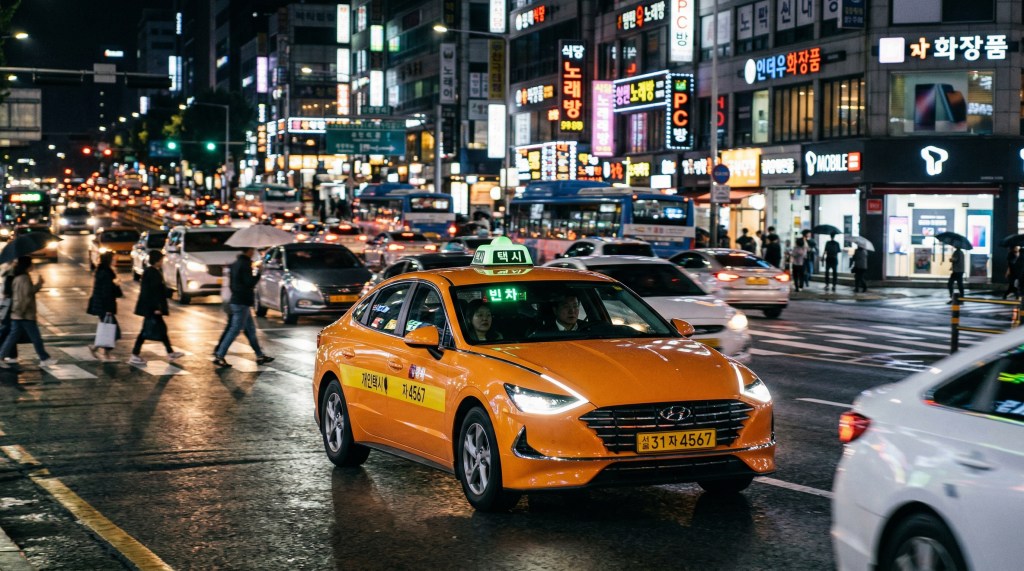
Korean taxis are one of the easiest parts of urban transport for visitors to use, especially because ride-hailing is widely simplified through the Kakao T app. But behind that convenience is a taxi system with several layers: different vehicle categories, fare differences by region and time, growing electrification, early autonomous taxi deployment, and a long-standing structure built heavily around personal taxis.
That makes Korean taxis worth explaining now. To a visitor, the system may look simple: open an app, choose a car, and go. In reality, it reflects a broader transition in Korean mobility.
Kakao T made Korean taxis much easier to use
For many locals and travelers, Kakao T is the default way to call a taxi in Korea. Its importance is practical rather than symbolic. It reduces the friction of finding a cab, shows available vehicle options, and makes payment and booking easier in a country where app-based convenience is now expected in everyday life.
For international readers, this matters because Korea’s taxi culture is no longer defined only by hailing a car on the street. The digital layer is central. Kakao T has made the system feel more legible by turning a fragmented transport market into a cleaner user experience.
In Korea today, the taxi experience often begins not on the street, but on the phone screen.
The main taxi types in Korea
One reason the system can confuse first-time users is that not all taxis are the same. In broad terms, Korean taxis are commonly divided into general taxis, personal taxis, deluxe taxis, and large taxis.
- General taxis: the most standard everyday option in many cities
- Personal taxis: individually operated taxis, which remain a major part of the system
- Deluxe taxis: higher-grade service with a more premium positioning
- Large taxis: bigger vehicles aimed at larger groups or luggage-heavy trips
App-based services can make these categories look even more segmented by branding, but the basic idea for visitors is simple: there is a standard tier, a premium tier, and a larger-capacity tier, all sitting within a broader taxi market.
Why taxi fares can feel inconsistent
Taxi base fares in Korea are not uniform nationwide. They vary by region and can also change depending on time of day, especially late at night. That means the price logic is not always immediately obvious to foreign users who expect a single national rule.
The research summary also points to large-taxi and deluxe-style service where surcharge rules can apply, especially during late-night hours or out-of-city travel. For visitors, the safest expectation is not a fixed universal fare, but a system where category, time, and location all matter.
Korean taxis are changing technologically
The taxi sector is also part of a broader mobility transition. One visible change is the growing shift toward electric vehicles. That transition matters because taxis are one of the most publicly visible parts of urban transport, so EV conversion is easy for ordinary riders to notice.
Another change is more experimental: late-night autonomous taxi services are beginning to appear. These early deployments should not be exaggerated into a full system transformation yet, but they do show the direction of travel. Korea’s taxi market is no longer only about conventional dispatch. It is increasingly tied to future mobility policy and technology testing.
The personal taxi system is one of the deeper issues
For international readers, one of the most unusual parts of Korean taxis is the role of personal taxi licenses. These licenses can be bought and sold, and the price range mentioned in the topic input—roughly 150 million to 200 million won—shows that this is not a minor administrative detail. It is an asset market.
That matters because it shapes how reform is discussed. If operating rights have become valuable tradable assets, then the taxi market is not just a transport service system. It is also a system of entrenched economic interests. This helps explain why institutional change can be difficult.
The topic input also notes that the Bank of Korea has suggested the need to innovate a structure centered heavily on personal taxis. Even without overextending that point, the implication is clear: Korea’s taxi system is efficient for users in some ways, but structurally old in others.
- User convenience is high: apps like Kakao T make calling taxis simple
- Market structure is more rigid: personal taxi ownership remains deeply embedded
- Licenses function like assets: this can make reform politically and economically sensitive
- Innovation is uneven: EV adoption and autonomous trials are advancing faster than some structural reforms
What international readers should take from this
Korean taxis are easy to use on the surface, but the system underneath is in transition. Visitors mostly experience the convenient side: app booking, multiple car types, and generally legible service options. But the deeper story includes pricing complexity, technology shifts, and a personal taxi structure that many observers see as overdue for change.
In short, Korea’s taxi market combines digital convenience, category diversity, and institutional inertia. That combination is exactly what makes it worth understanding.
Photo by Hyeok Jang on Pexels



 Trend Kr
Leave a comment