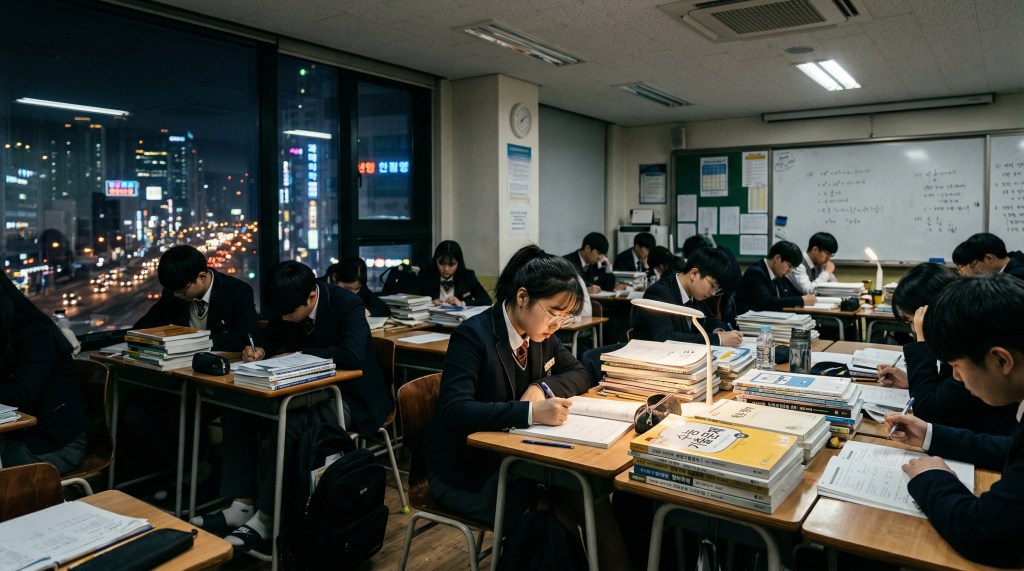
South Korea’s private education system is not simply about studying harder after school. For many middle and high school students, it is part of a much larger structure linking academic performance, the CSAT exam, university entry, employment prospects, and social status. That is why the topic matters now. To understand Korean youth culture, it is not enough to look at classrooms alone; you also have to look at the pressure surrounding them.
For international readers, the key Korean term is sagyoyuk, meaning private education. In practice, this often includes hagwons, private academies where students study after regular school hours, along with tutoring and other forms of exam-focused preparation. In Korea, this world is so large and so normalized that it can feel less like a supplement to public education and more like a second education system running beside it.
Middle and high school are shaped by entrance competition
One reason private education is so powerful in Korea is that it becomes meaningful long before university applications are actually submitted. Middle and high school students often study under the assumption that current performance will shape future options. That means academic competition is rarely experienced as temporary. It is experienced as cumulative.
The research summary supports this broad picture. It points to an overheated entrance-exam-centered education culture and to a reality in which students often feel anxious even when they do not want to keep studying. That is important. The issue is not only ambition. It is also fear of falling behind in a system where comparison feels constant.
In South Korea, students are often taught not only to learn, but to stay ahead.
Why the CSAT matters so much
For many outsiders, the structure becomes clearer through one exam: the CSAT, or College Scholastic Ability Test, known in Korean as Suneung. This exam has symbolic power far beyond a single test day. It represents the concentration of years of effort, household investment, and social expectation into one high-stakes national event.
That does not mean the entire system can be reduced to one exam. School records, internal assessments, and admissions strategies also matter. But the cultural weight of the CSAT helps explain why private education remains so persistent. If one exam can influence university pathways so heavily, families naturally search for every possible advantage.
- Private education becomes normalized: students often treat after-school study as standard, not exceptional
- Exam pressure starts early: preparation is linked to future competition long before the final year of high school
- The CSAT concentrates anxiety: one national exam carries outsized symbolic and practical importance
- University entry is treated as social sorting: admissions are often understood as affecting far more than campus life
University prestige and the job market are closely linked
The deeper reason this system feels so intense is that education in South Korea is rarely treated as education alone. It is also tied to employment, income stability, and social recognition. This is why discussions of teenagers can quickly turn into discussions of jobs. Even before entering university, many students absorb the idea that the right school can shape the rest of their life.
The research summary points toward this broader issue through references to credentialism and the idea that education is often treated as a means of securing status. That is a crucial point. In such a society, university admission can come to feel less like intellectual development and more like entry into a hierarchy.
For international readers, this helps explain why Korean students can seem to be preparing for employment long before they enter the labor market. The pressure is anticipatory. Teenagers are not only studying for grades; they are studying within a system that constantly hints at future sorting.
Private education also sharpens inequality
Another reason private education draws so much criticism is that it can deepen inequality. When access to better preparation depends on money, time, and parental strategy, educational competition becomes uneven from the start. The research summary directly notes concerns that the growth of private education has produced inequality depending on whether students receive it.
This is one of the most important social facts behind the system. If private education is widespread enough to feel necessary, but expensive enough to be unequal, then the competition is not fully merit-based even when it presents itself that way. That contradiction is part of what makes the Korean education debate so emotionally charged.
Why this is a social culture story too
It is tempting to describe all of this in administrative terms—tests, admissions, school records, resumes—but the system also shapes youth culture. It changes how teenagers spend time, what families worry about, and how success is imagined. Even popular dramas and youth-focused cultural works gain traction partly because they tap into a wider recognition: school life in Korea is not only about friendship or adolescence, but also about pressure, ranking, and future uncertainty.
At the same time, there are signs of fatigue. The research summary includes a telling remark from a young person who appreciated a space where people did not constantly talk about employment. That matters because it suggests how deeply job anxiety has entered youth life. When not discussing jobs feels refreshing, the social atmosphere is already saturated with career pressure.
Conclusion
South Korea’s private education system matters because it links adolescence to the wider hierarchy of adult life. For middle and high school students, private education is tied to exam pressure, the CSAT, university competition, and eventually the job market. That is why it remains so powerful and so controversial. It promises mobility, but it also reproduces anxiety and inequality. For international readers, the clearest way to understand it is not as a narrow school issue, but as one of the central systems through which Korean society organizes hope, fear, and status.
Photo by Aibek Skakov on Pexels


 Trend Kr
Leave a comment