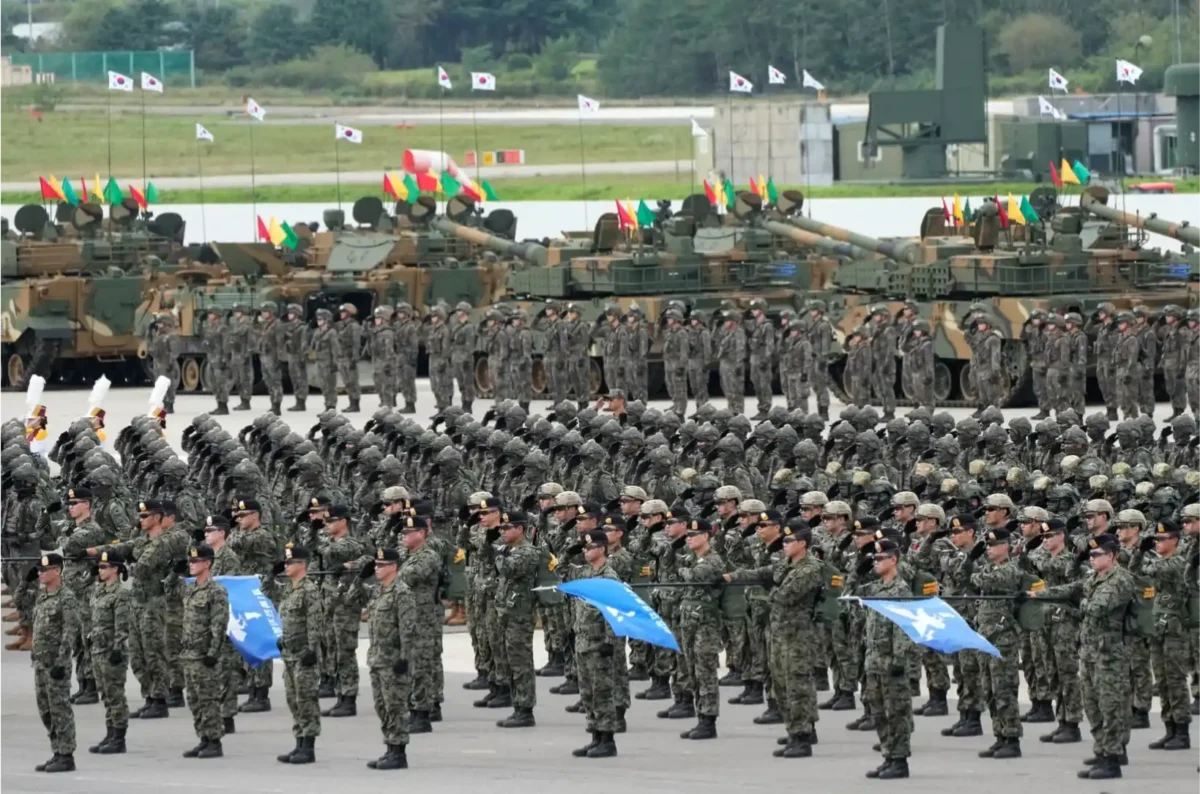
South Korea lives in a dangerous neighborhood, and its military posture shows it. The country is often discussed as if it were simply reacting to North Korea. That understates the scale of what it has built. By the 2026 Global Firepower ranking, South Korea is 5th out of 145 countries, with a Power Index score of 0.1642. Japan ranks 7th with 0.1876. North Korea ranks 31st with 0.5933.
That is the clearest starting point: South Korea is not a small frontline military punching above its weight. It is already one of the world’s top conventional military powers.
South Korea is strong because it combines money, manpower, and readiness
A lot of countries have one of those three. South Korea has all three at once.
Global Firepower lists South Korea’s 2026 defense budget at $44.8 billion. Separately, Yonhap reported that the South Korean government proposed a 2025 defense budget of 61.59 trillion won, or about $46.3 billion, up 3.6 percent from 59.42 trillion won the year before. If approved, Yonhap said, it would mark the first time the country’s defense budget passed 60 trillion won.
The manpower picture is equally large. Global Firepower estimates 450,000 active personnel, 3,100,000 reserve personnel, and 120,000 paramilitary personnel, for an estimated total military-related manpower pool of 3,670,000. It also lists 26,040,900 available manpower and 21,353,538 fit-for-service personnel.
Those numbers matter because South Korea is not built around a tiny professional military. It is built around a substantial active force backed by a very large reserve structure. That reserve depth is one of the least glamorous but most consequential parts of its military strength.
| Category | South Korea |
|---|---|
| 2026 Global Firepower rank | 5 of 145 |
| Power Index | 0.1642 |
| Active personnel | 450,000 |
| Reserve personnel | 3,100,000 |
| Paramilitary | 120,000 |
| Total military personnel (est.) | 3,670,000 |
| 2026 GFP defense budget | $44.8 billion |
| 2025 proposed official budget | 61.59 trillion won ($46.3 billion) |
The land force is where the scale becomes obvious
If you want to know why South Korea ranks so high, start with the army and artillery figures.
Global Firepower lists 1,831 tanks, 117,460 vehicles, 2,780 self-propelled artillery systems, 5,800 towed artillery pieces, and 525 multiple-launch rocket systems. Those are not symbolic numbers. They place South Korea near the very top globally in several categories. Global Firepower ranks it 3rd in self-propelled artillery and 2nd in towed artillery.
This is not an accident. South Korea’s military was designed around the reality of a heavily armed peninsula, a short-warning environment, and the need for large-scale conventional firepower. It did not build a lightweight expeditionary force. It built a force that assumes volume matters.
That also explains why South Korean equipment discussions often center on artillery and armored systems first. In a regional crisis, those systems are not secondary. They are central.
Its air and naval strength are stronger than many outsiders assume
South Korea is often described through its army because of the Korean Peninsula’s geography. That is accurate, but incomplete.
Global Firepower lists 65,000 air force personnel and 70,000 navy personnel. On the naval side, it counts 215 total assets with 427,946 tonnes of total tonnage, including 2 helicopter carriers, 14 destroyers, 18 frigates, 3 corvettes, 22 submarines, 96 patrol vessels, and 14 mine warfare vessels.
That mix matters. South Korea is not trying to match the United States or China at blue-water scale, but it does field a serious navy with destroyers, submarines, and amphibious capability. For a state whose main security threat is still on land, that is substantial.
The same applies to air power. The supplementary material references the KF-21 prototype in a 2024 Yonhap budget report, which signals that South Korea is not only maintaining its force but investing in the next generation of domestic capability. South Korea’s military strength is not just about stockpiles. It is also about industrial capacity and modernization.
South Korea’s military is not large in one category and thin everywhere else. It is broad, layered, and funded well enough to stay modern.

Its structure is built for a real war, not a parade
The Republic of Korea Armed Forces are organized around the Army, Navy, Air Force, and Marine Corps, backed by a large reserve system. The source material also points directly to separate organizational pages for the navy, marine corps, and air force, which is a reminder that the military is not a single block. It is a full-service force with distinct branches and missions.
The reserve element is especially important. Global Firepower’s estimate of 3.1 million reservists gives South Korea a level of wartime depth that changes the meaning of its active-force size. A country with 450,000 active troops looks one way on paper. A country with 450,000 active troops plus 3.1 million reserves looks very different.
There is a counterargument here. Some analysts will say reserve numbers can exaggerate actual wartime effectiveness, since reservists are not equivalent to full-time front-line units. That is true. Reserve depth is not the same thing as immediate combat readiness. But for South Korea, the reserve system is not decorative. It is part of the core defense design. In a prolonged crisis, numbers like that are strategically meaningful.
Japan and North Korea frame South Korea’s position in very different ways
Comparing South Korea with Japan and North Korea helps clarify what kind of military power it is.
Against Japan, the comparison is between two advanced, wealthy states with strong technology bases. Global Firepower ranks South Korea 5th and Japan 7th. Japan has the advantages of island geography and a much longer coastline at 29,751 km, while South Korea has a 237 km shared border and a much more immediate land threat. South Korea’s force structure is therefore more land-war focused, while Japan’s strategic posture is more maritime and air oriented. The two militaries are both strong, but they are built for different problems.
Against North Korea, the comparison is less flattering to Pyongyang than headlines sometimes imply. Global Firepower ranks North Korea 31st, far below South Korea’s 5th, and assigns it a much weaker Power Index score of 0.5933. It also lists North Korea’s defense budget at $4.75 billion, a fraction of South Korea’s. That said, Global Firepower itself warns that North Korean capabilities are hard to measure and often estimated. North Korea remains dangerous because of geography, missile and nuclear programs, massed artillery, and opacity. It does not need to outrank South Korea conventionally to remain a severe threat.
| Country | 2026 GFP Rank | Power Index | Defense Budget |
|---|---|---|---|
| South Korea | 5 | 0.1642 | $44.8 billion |
| Japan | 7 | 0.1876 | Not cited here |
| North Korea | 31 | 0.5933 | $4.75 billion |
The verdict: South Korea is a global top-tier conventional military
South Korea’s military strength is real, broad, and measurable. A 5th-place global ranking, a defense budget above 60 trillion won on the official 2025 proposal, 450,000 active personnel, 3.1 million reserves, and top-tier artillery and naval numbers put it firmly in the first rank of conventional military powers.
The limiting fact is not weakness. It is geography. South Korea has built one of the world’s strongest militaries because it has to live next to one of the world’s most dangerous unresolved conflicts.
Image Credits: Image from defensefeeds.com (editorial use) · Image by Ray_Shrewsberry on Pixabay

Leave a Reply