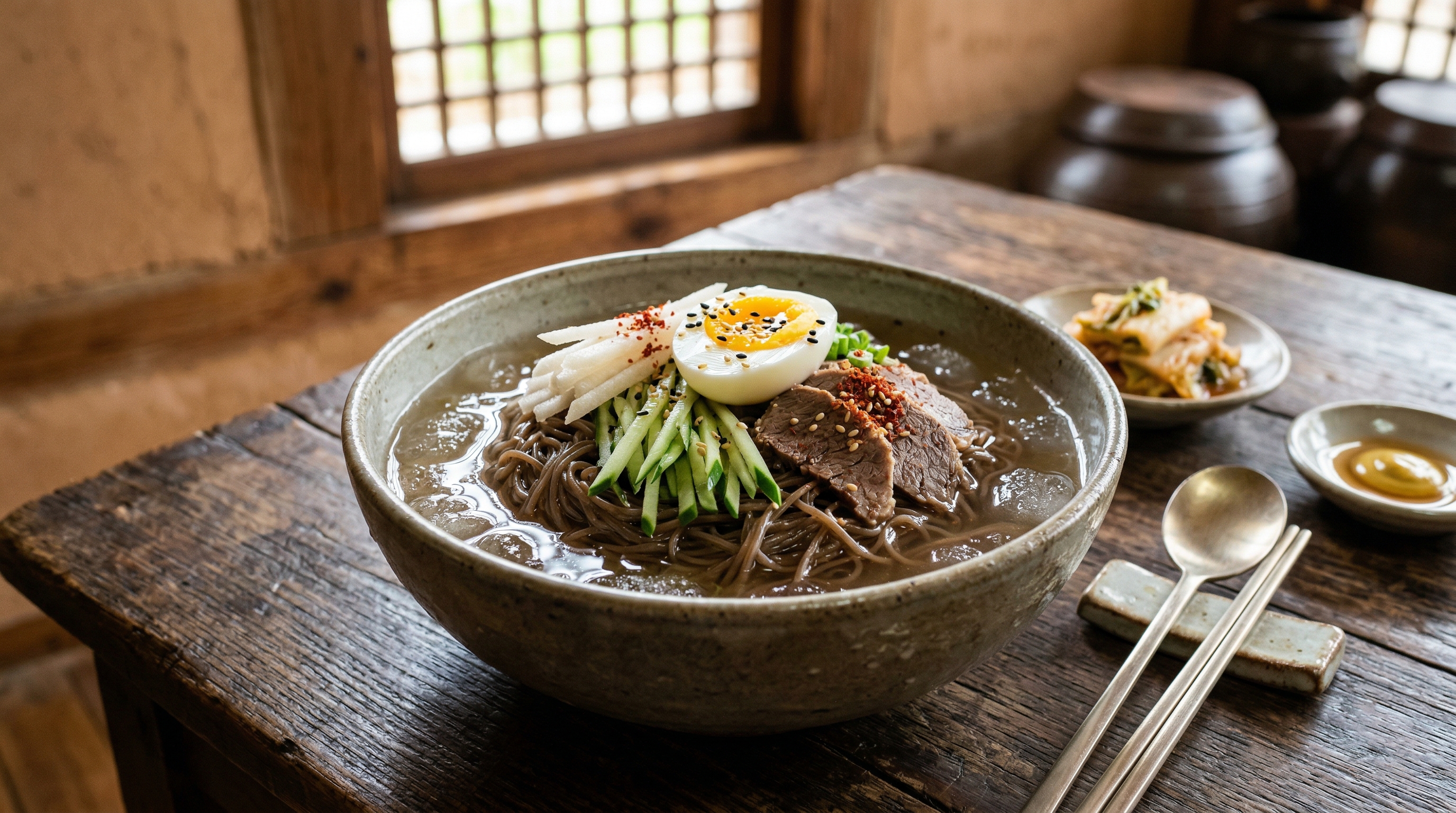
Few Korean foods create so much argument for something served cold.
Put a bowl of naengmyeon in front of a Korean table and you are no longer just eating noodles. You are entering a conversation about region, memory, broth, mustard, vinegar, texture, and whether the person across from you has any idea what they are talking about. This is not an exaggeration. Koreans can get weirdly serious about cold noodles.
And honestly, they should. Naengmyeon is one of those dishes that looks simple from the outside and turns out to carry half a history lesson inside the bowl.
Naengmyeon is not one dish. It is a family of cold noodle cultures.
The Korean word naengmyeon simply means “cold noodles,” but that translation is too tidy. In practice, naengmyeon refers to several related traditions built around chilled noodles, cold broth or sauce, and a very specific style of clean, sharp satisfaction.
The major branches most people encounter are these:
- Pyongyang naengmyeon — subtle, broth-centered, usually buckwheat-heavy, and famous for restraint
- Mul-naengmyeon — cold noodles in broth, often associated broadly with the water-based side of the naengmyeon world
- Bibim-naengmyeon — mixed cold noodles with a spicy sauce instead of a full cold broth
- Hamheung-style influence — often associated with chewier noodles and the lineage behind spicy mixed versions
That already explains part of the confusion. People say “naengmyeon” as if everyone is talking about the same thing. They are not.
Naengmyeon is one of Korea’s cleanest examples of a food that sounds simple and behaves like an identity test.
The roots go back north, and they go back far
The broad historical story most Koreans grow up hearing is that naengmyeon came from the colder northern part of the Korean Peninsula, especially places like Pyongyang and Hamheung. One commonly repeated origin story ties the dish to long northern winters, buckwheat-based noodles, and chilled dongchimi—a watery radish kimchi broth that could be used as a cold soup base.
That origin makes sense climatically and culturally. It also explains why the dish carries such strong northern associations even in South Korea. Historical references to naengmyeon go back centuries, and over time the dish moved, changed, and split into regional and stylistic traditions that still matter today.
This is why cold noodles in Korea are not merely “summer food,” even though that is when many people crave them most. They are also a historical inheritance from a very different food geography.
Pyongyang naengmyeon: the style that teaches patience
If Korean cold noodle culture has a prestige language, it is Pyongyang naengmyeon.
This style is often built around buckwheat noodles and a very light, restrained broth, sometimes shaped by beef stock, dongchimi notes, or both. To people who love it, it is elegant, deep, and honest. To first-timers, it can taste like almost nothing happened.
That is part of the charm. Or part of the joke, depending on who is talking.
Pyongyang naengmyeon is one of those dishes that many Koreans say you have to learn how to appreciate. It does not slap you with flavor. It asks you to notice small things: the grainy softness of the noodles, the quiet chill of the broth, the way the whole bowl feels clean rather than dramatic.
That is why devoted fans sound almost religious about it. Once the dish clicks, they treat subtler bowls as higher forms of civilization.
Mul-naengmyeon and bibim-naengmyeon: the split most diners actually know
Outside specialist arguments, the more familiar restaurant-level choice in South Korea is often between mul-naengmyeon and bibim-naengmyeon.
Mul-naengmyeon means cold noodles in chilled broth. It is the version many people picture first: long noodles, icy or very cold soup, sliced cucumber, radish, egg, sometimes meat, and the little ritual of deciding whether to add mustard or vinegar.
Bibim-naengmyeon is the spicier sibling, built around a red seasoning sauce instead of a clear cold broth. It is brighter, louder, and more immediately legible. If Pyongyang-style cold noodles can feel like a whisper, bibim-naengmyeon is the dish clearing its throat across the room.
And yes, the sugar question matters too. Background reporting on sugar content has noted that bibim-naengmyeon can contain significantly more sugar than water-based naengmyeon, sometimes by a large multiple. That is not the main cultural story, but it does help explain why bibim-naengmyeon often tastes bolder and more addictive from the first bite.

Makguksu belongs in the same conversation, even if it isn’t the same thing
If you spend enough time around Korean noodles, makguksu eventually enters the chat.
Makguksu is not identical to naengmyeon, but it lives close enough to the same cold-noodle world that people often think about them together. It is especially associated with buckwheat and Gangwon-style noodle culture, and it can appear in both broth-based and mixed forms. Compared with Pyongyang naengmyeon, makguksu often feels earthier, more direct, and a bit less ceremonial.
That difference is useful. Naengmyeon, especially in its prestige forms, can carry a lot of symbolic weight. Makguksu often feels more casual and more openly rustic. Same broader family mood. Different personality.
Why Koreans eat naengmyeon after meat
One of the most recognizable things about naengmyeon in South Korea is where it often appears: after barbecue.
This is not an accident. Go out for grilled beef or pork, and there is a very good chance someone at the table will order cold noodles afterward. The logic is obvious once you try it. After hot, fatty, smoky meat, a bowl of cold noodles resets the palate. It cools the body, sharpens the mouth, and somehow makes the meal feel finished rather than simply stopped.
That is why naengmyeon has become so strongly tied to Korean meat culture. It works almost like a structured ending.
- Meat gives richness and heat
- Cold noodles bring chill, acidity, and contrast
- The meal feels balanced once both happen
Some foods are side dishes. Naengmyeon is often the aftertaste strategy.
Places like Jeongin Myeonok matter because naengmyeon has its own canon
In Korea, cold noodle culture is also restaurant culture. People do not just say they want naengmyeon. They often say they want this shop’s naengmyeon.
That is where places like Jeongin Myeonok come in. Restaurants with a strong reputation become part of the broader naengmyeon map, especially in Seoul, where people are willing to travel for a specific broth style, noodle texture, or old-school lineage. A famous cold noodle shop is not just a place to eat. It is part of a national ranking system that exists mostly in people’s heads and causes endless arguments.
This is also why naengmyeon is such a good window into Korean food culture more broadly. Koreans love categories, lineages, local loyalties, and the idea that subtle differences matter deeply. Cold noodles give them all four.
Why this food means more than it first seems
From the outside, naengmyeon can look almost comically minimal. Noodles. Cold broth or sauce. A few toppings. Hardly the kind of dish that should inspire obsession.
And yet it does. Because under that calm surface sits a lot of Korean history: north-south memory, regional identity, restaurant tradition, seasonal habit, and the very Korean pleasure of turning a meal into a debate.
That may be the best way to understand naengmyeon. It is not just refreshing. It is culturally dense. A bowl of Pyongyang naengmyeon, bibim-naengmyeon, or makguksu is never just a bowl if you are eating it in Korea. It is a position, a preference, a memory, and sometimes a challenge. The real question is not whether cold noodles deserve this much attention. It is why so many other foods get away with offering so much less.
Image Credits: AI-generated editorial images
Leave a Reply