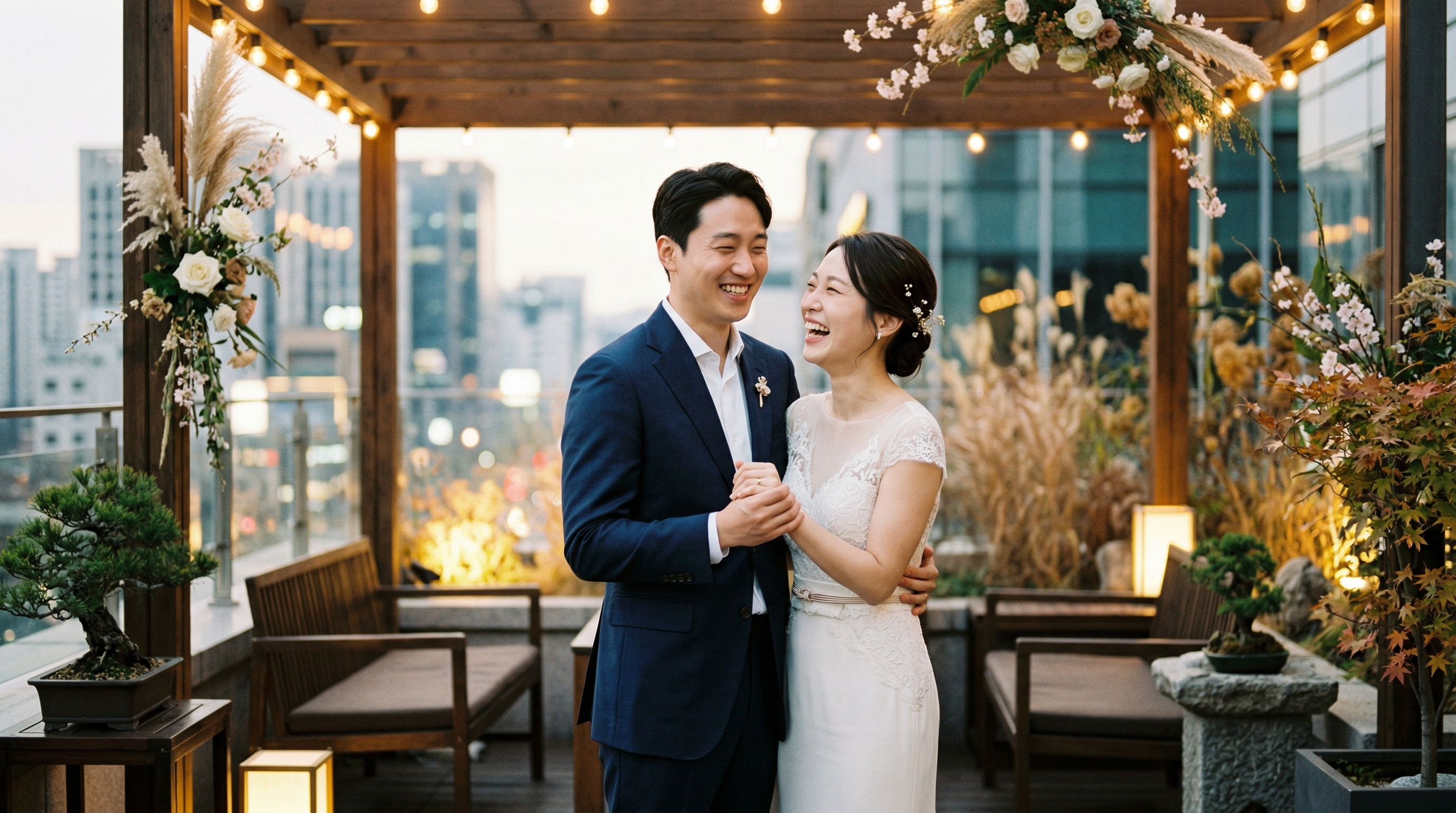
Some trends explode because they are huge. Others explode because they reveal something people were not ready to admit had already changed.
The recent rise in marriages between Korean men and Japanese women belongs to the second category. The numbers are not massive enough to transform society on their own. But they are striking enough to signal a shift in something deeper: familiarity.
For years, Korea and Japan were often discussed through politics, historical tension, and periodic diplomatic chill. That story is still real. But it is no longer the only one. Underneath it, a quieter social change has been building through travel, entertainment, online life, and a younger generation that often experiences the neighboring country less as an enemy image and more as a place they actually know something about.
The numbers are why people started paying attention
The immediate reason this topic is drawing notice is simple: the increase has been sharp enough to stand out.
According to recent reporting based on official data, there were 840 marriages in 2023 between Korean men and Japanese women, up 40.1 percent from 599 the year before. Reporting on the following year went even further, citing 1,176 such marriages in 2024. That same reporting noted just 147 marriages between Korean women and Japanese men in 2024.
Those figures do not mean this has become the dominant form of marriage in either country. Obviously not. But they are large enough to trigger a public reaction, especially because Korea-Japan relationships have long carried more symbolic weight than the raw numbers alone would suggest.
The real story is not just that the numbers rose. It is that they rose in a relationship once defined more by distance than by familiarity.
Korea has become much more visible inside Japan
You cannot understand this trend without understanding K-content.
South Korea’s cultural visibility in Japan has changed dramatically over time. Korean dramas, K-pop, beauty products, fashion, food, and celebrity culture have all made Korea feel more present in everyday Japanese media consumption. That does not mean every consumer turns into a cross-border romantic prospect, obviously. But it does mean the baseline sense of Korea as distant, abstract, or culturally hard to read has weakened.
This matters because relationships need familiarity more than they need headlines. Once a country becomes more legible through entertainment and soft power, its people often do too. A face on a screen is not the same as a real person, but it lowers the emotional barrier to curiosity.
And curiosity matters. A lot.
Travel did what politics often could not
There is another reason this shift feels more plausible now: people can actually meet each other more easily.
Korea and Japan are geographically close, and travel between the two countries has become normal enough for younger people to treat it less like a grand foreign adventure and more like a manageable regional trip. Short flights, city breaks, concerts, beauty shopping, food travel, and casual tourism all make repeated contact easier.
This kind of proximity changes the social atmosphere. It replaces imagined knowledge with lived experience. Once people have visited Seoul, Busan, Tokyo, Osaka, or Fukuoka a few times, the neighboring country starts feeling less like “abroad” in the dramatic sense and more like a reachable extension of everyday East Asian life.
That does not erase national differences. It just makes those differences feel navigable rather than forbidding.
The sense of economic distance has narrowed
For a long time, Korea-Japan comparisons carried a built-in hierarchy in many people’s minds. Japan was often perceived as more economically established, more globally dominant, and more socially prestigious. That gap has not disappeared in every sense, but it has clearly narrowed in perception.
South Korea’s rise in technology, pop culture, design, beauty, and global visibility has changed how the country is seen in the region. Korea no longer reads as an underdog next to Japan in the way it once often did. That matters in subtle ways.
Cross-border relationships are affected not only by personal chemistry, but by how two societies imagine each other. When the symbolic status gap narrows, relationships can feel more equal, more normal, and less burdened by older assumptions.
On paper, this sounds abstract. In practice, it changes who seems imaginable as a partner.

The internet made Korea-Japan couples visible in a new way
Another important piece is online visibility.
As recent reporting has noted, Korea-Japan couples have become more noticeable through YouTube and other platforms. That matters because online visibility does something powerful: it turns isolated cases into a recognizable social pattern.
Once people start seeing real couples sharing language struggles, family meetings, food differences, travel routines, and ordinary relationship life, the idea of a Korea-Japan marriage stops feeling exceptional. It becomes narratable. Reproducible. Socially imaginable.
- Travel makes meeting easier
- K-content makes Korea more culturally familiar
- Online couples make the relationship model visible
- Younger audiences absorb all of this as normal social information
This is how a trend can gain momentum without any single dramatic cause. Visibility accumulates until the once-unusual starts to look obvious.
Younger generations often carry less inherited distance
It would be naive to claim that historical issues between Korea and Japan no longer matter. They absolutely do. But younger generations in both countries often move through a slightly different social environment from the one their parents inherited.
They are more likely to have consumed each other’s media. More likely to have traveled. More likely to interact online. More likely to understand the neighboring country through friends, influencers, language study, pop culture, or daily digital exposure rather than through textbook-era tension alone.
That does not make them apolitical. It does make them less trapped inside older emotional scripts.
And when bilateral social attitudes improve even modestly at the everyday level, relationship possibilities expand. Not because everyone suddenly becomes cosmopolitan and enlightened, but because the basic friction drops.
What this trend does not prove
This is where the discussion needs some discipline.
The rise in these marriages does not prove sweeping personality claims about Korean men or Japanese women. It does not prove one country has become romantically superior. It does not prove cultural differences vanished. And it should not be turned into a fantasy market of national stereotypes, which is exactly where internet conversations often go to become useless.
The more serious explanation is less dramatic and more convincing: people form relationships more easily when the neighboring society feels familiar, visible, reachable, and less burdened by symbolic distance than before.
Cross-border marriage trends usually tell you less about national essence than about how much the distance between two societies has quietly shrunk.
Why this matters beyond the marriage statistic
The reason this topic matters is not only romance. It is that marriage is one of the clearest markers of social closeness. Tourism can rise for shallow reasons. Media can travel without trust. But marriage suggests something heavier: people are willing to tie families, futures, and daily life together across a border that once felt more emotionally charged.
That does not mean Korea and Japan have solved their historical tensions. They have not. It does mean that below the level of official disputes, a more ordinary form of regional intimacy has been growing.
And that may be the most interesting part of all. The real shift is not that some Korea-Japan marriages now attract attention. It is that they are becoming easier to imagine without surprise. Once that happens, the statistics matter—but the quieter social change behind them matters more. The next question is whether politics will keep lagging behind a generation that has already started acting like the distance is smaller than it used to be.

Image Credits: Photo by Khan Ishaan on Pexels · Photo by Theodore Nguyen on Pexels


Leave a Reply