Ten years ago, immigration in South Korea felt like a topic many people would rather avoid. It was often discussed in anxious terms—cultural difference, social discomfort, vague fears about cohesion. Today, those anxieties have not disappeared. But they are no longer the whole story.
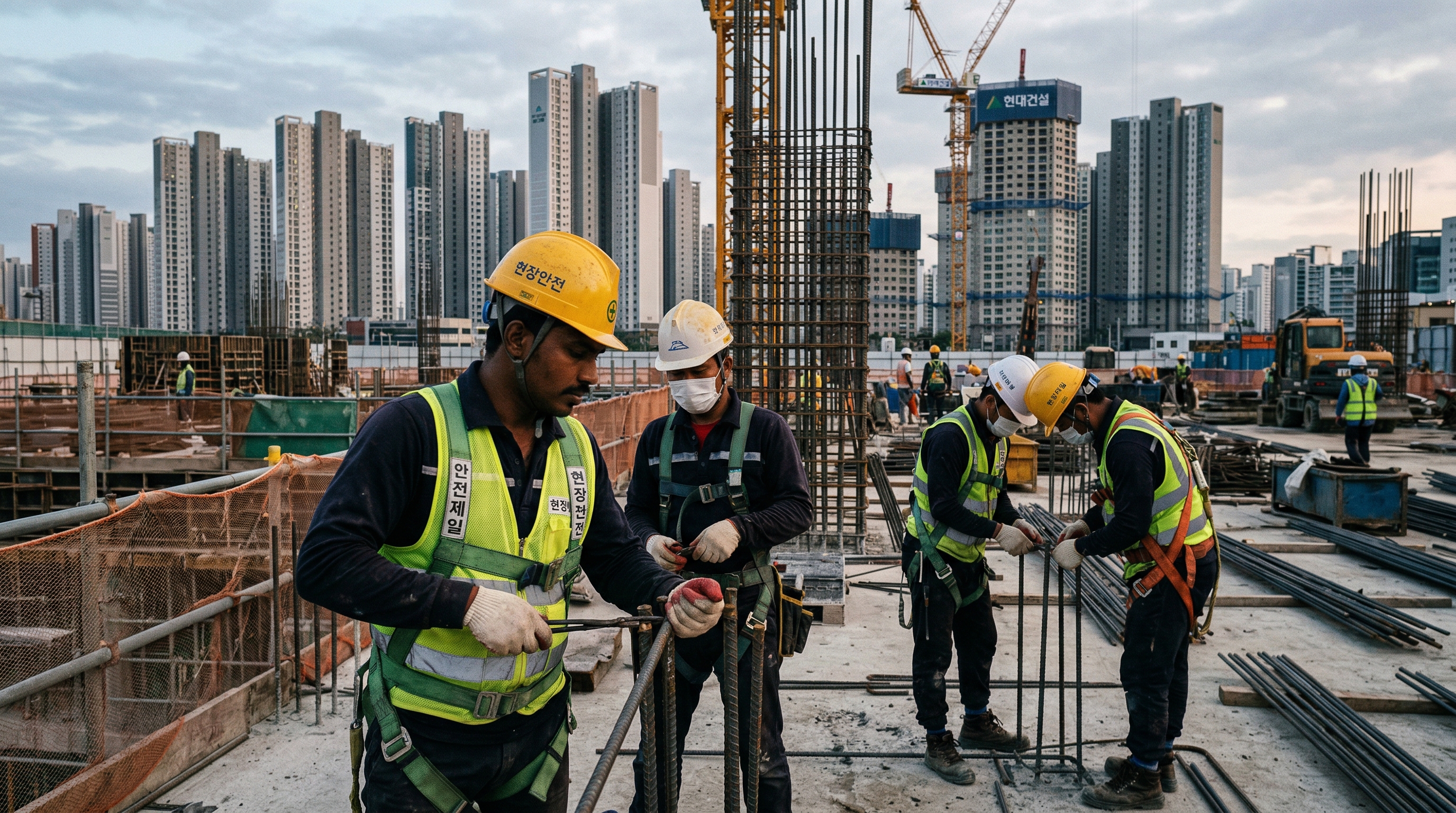
The country is changing in a more practical direction, and you can see it without reading a single policy paper. Look around a restaurant. Look at a logistics hub. Look at a factory town, a farming area, or a construction site. Foreign workers are far more visible in daily Korean life than they were a decade ago. That visibility has changed the debate.
Not because South Korea suddenly became ideologically open. It did not. It changed because labor shortages started winning arguments that morality and multicultural theory never could.
South Korea used to talk about immigration more defensively
For years, public resistance to immigration was stronger and more reflexive. Korea’s self-image as an ethnically and culturally cohesive society made many people uneasy about rapid demographic change. Immigration was often imagined as a disruption rather than a normal feature of a modern economy.
That instinct still exists. But the government and wider society have spent years trying, at least unevenly, to soften it. Research on Korean attitudes toward migrants notes that policy and educational efforts have aimed to improve receptivity toward other cultures and reduce exclusionary attitudes. That matters because it shows the shift did not happen by accident. Korea has been pushed, institutionally as well as economically, toward a more multicultural reality than many citizens initially wanted.
South Korea did not become more open because it resolved its discomfort. It became more open because discomfort stopped being enough to solve the labor problem.
Foreign workers are now part of ordinary daily life
One of the biggest changes over the past decade is visibility. Immigration used to feel easier for many Koreans to discuss in abstract terms. That is harder now, because migrant labor is no longer hidden in the background.
Today, foreign workers are much easier to see in:
- Restaurants and food service
- Factories and manufacturing sites
- Farms and fisheries
- Logistics and warehouse work
- Construction sites
This matters socially as much as economically. Once migrants become part of the visible system of everyday life, public opinion changes in a more grounded way. People may still hold prejudice. They may still feel unease. But the idea that immigration is some distant or optional issue becomes much harder to maintain when the person serving lunch, sorting packages, or helping keep a job site running is right in front of you.
Visibility does not automatically produce empathy. But it does make denial harder.
The labor shortage is the real engine behind policy change
If there is one force driving South Korea toward a more pragmatic immigration policy, it is not cultural liberalism. It is labor scarcity.
South Korea is aging. Birth rates remain extremely low. Many manual, physically demanding, and lower-wage sectors struggle to recruit enough domestic workers under current conditions. Once that happens at scale, governments do not get to treat immigration as a symbolic issue forever. They have to treat it as infrastructure.
This is especially true in sectors where the gap between labor demand and local willingness is difficult to close. It is one thing to say a country should rely on its own workforce. It is another to explain who exactly will work in underfilled farms, factory lines, logistics operations, or construction crews when too few local workers are willing or available to do so.
That is the point at which immigration stops being a philosophical argument and becomes a labor-market necessity.

Outside Seoul, the pressure is often even stronger
Seoul dominates the image of South Korea, but the immigration story often becomes clearer once you look beyond the capital.
Outside Seoul, especially in regional and rural areas, labor shortages can feel sharper and harder to disguise. Factories still need staff. Farms still need seasonal and ongoing labor. Local economies still need workers even when younger Korean populations shrink, age, or move toward the capital region.
This is one reason regional Korea often encounters immigration less as an abstract political question and more as a practical fact of economic survival. If the local labor pool is too small, too old, or too unwilling to take certain jobs, the discussion becomes brutally simple: either foreign labor comes in, or the sector weakens further.
You would expect national identity debates to dominate. In practice, staffing problems often dominate faster.
But more migration does not mean equal acceptance
This is where the conversation needs honesty. A more pragmatic immigration policy does not mean South Korea has become uniformly welcoming. Research and public reporting still point to discriminatory attitudes toward foreign workers, and social unease remains real.
That unease shows up in several ways:
- Conservative resistance to demographic change
- Suspicion toward low-wage foreign labor
- Exclusion from full social belonging
- Uneven treatment in daily life and institutions
Background material also points to patterns of exclusion affecting some migrant groups more than others, especially those with lower social status or weaker language and social networks. That matters because immigration policy is not just about entry. It is about who gets to belong once they are already there.
And here South Korea remains conflicted. The country is becoming more dependent on migrants faster than it is becoming emotionally comfortable with them.
Korea’s real challenge is shifting from labor use to social integration
For a while, governments can treat migrant workers mainly as an economic input. Bring people in. Fill labor gaps. Keep the machine running.
That model works only up to a point.
Once migrants become part of long-term social reality, a harder question appears: is South Korea building a labor import system, or an immigration society? Those are not the same thing. A labor import system focuses on staffing shortages. An immigration society has to think about language support, legal stability, discrimination, access to services, schools, healthcare, family life, and long-term integration.
And this is where Korea still looks transitional. It is more open than it used to be. It is more dependent on foreign workers than many people admit. But it is still not fully comfortable with the consequences of that dependency.
The next stage of Korea’s immigration debate is not about whether migrants are needed. It is about whether they will be treated as temporary labor or as part of the country’s future.
What changed most over the past decade
The biggest change is not that opposition disappeared. It did not. The biggest change is that the balance of the argument moved.
A decade ago, resistance could sound principled, cultural, or protective. Today, that position has to compete with the obvious reality that foreign workers are already helping hold up parts of the Korean economy. That does not erase prejudice, but it does weaken the fantasy that immigration is optional.
South Korea has become more pragmatic because it had to. Aging, labor shortages, and regional decline made the old posture harder to sustain. Some citizens remain uneasy. Some conservatives still resist. Some migrants still face exclusion and unequal treatment. All of that remains true.
But another truth now sits beside it: Korea is already more immigrant-dependent than many of its old assumptions were designed to handle. The real question is no longer whether the country can avoid that reality. It is whether it can build a social and political framework mature enough to live with it honestly.
Image Credits: Photo by Huy Phan on Pexels · Photo by Theodore Nguyen on Pexels

Leave a Reply