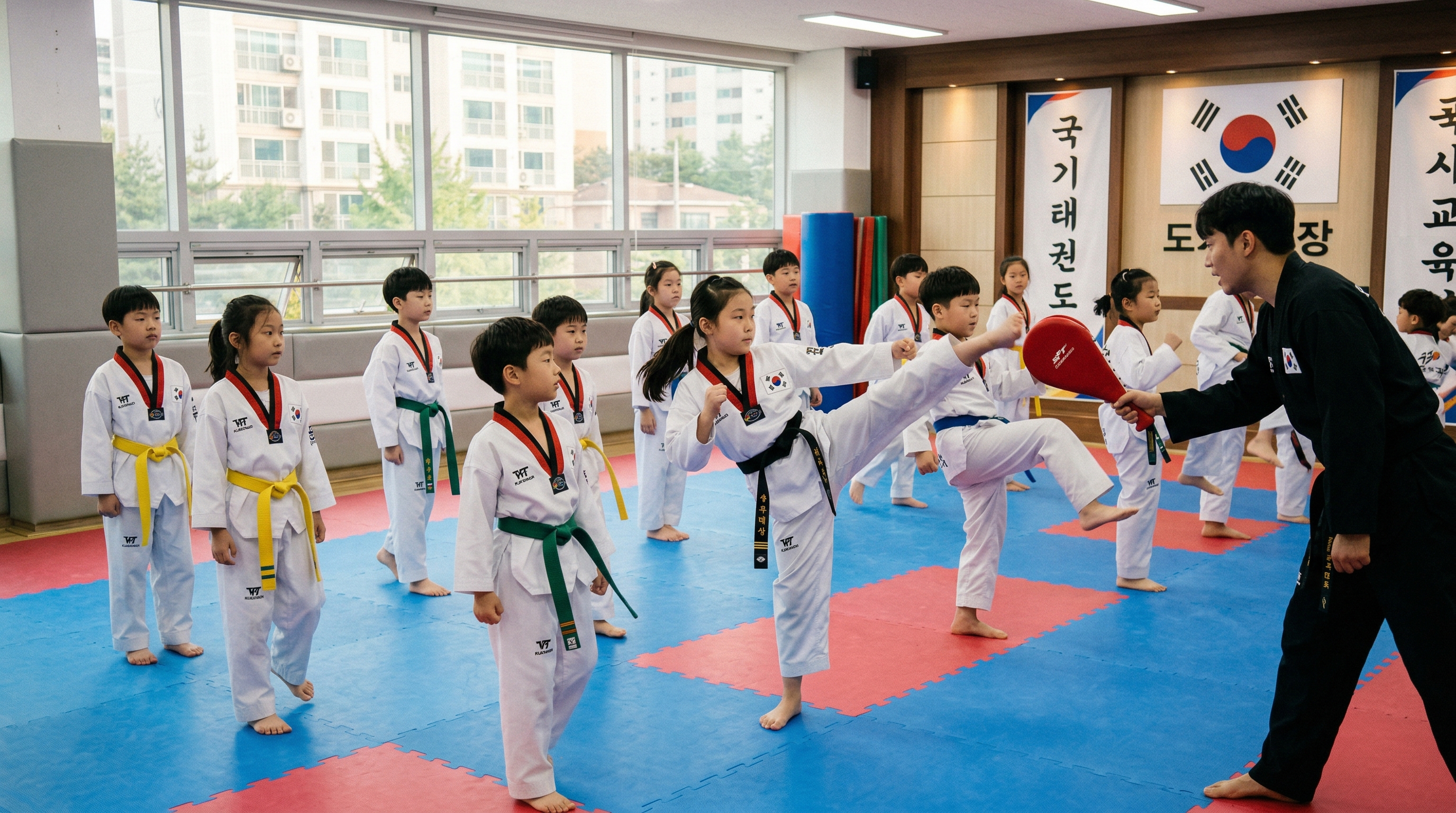
If you spend enough time in a South Korean neighborhood, especially one with an elementary school nearby, you start noticing a pattern. There is almost always a taekwondo academy somewhere close. Sometimes two. Often with cheerful signage, small buses, and a stream of children in uniforms moving in and out around late afternoon.
This is one of the easiest ways to misunderstand taekwondo in Korea. From the outside, it looks like the country’s proud national martial art must be treated with constant solemnity. Inside Korea, the reality is much more ordinary and much more revealing.
Yes, taekwondo is a global sport. Yes, Korea is absolutely a major taekwondo power. But in everyday life, taekwondo is also just one of the most common forms of children’s after-school physical education.
Taekwondo in Korea is both prestigious and strangely normal
This is the first thing international readers need to understand: taekwondo in South Korea has two identities at once.
On one level, it is a national symbol—closely tied to Korean identity, international sporting prestige, and the country’s global cultural footprint. It has deep symbolic importance and a very visible place in how Korea presents itself to the world.
On another level, it is just… local infrastructure. A place where parents send children to move around, burn energy, build discipline, and spend an hour not staring at a screen.
In Korea, taekwondo is both national heritage and neighborhood childcare with kicking.
That contrast is not disrespectful. It is actually the reason the system works so well. Taekwondo survives not only because it is admired, but because it is woven into ordinary family life.
Yes, taekwondo is an Olympic sport, and Korea is one of its major powers
Taekwondo’s status as a modern international sport is real and important. The version most people now see in global competition is tied to the WT system—the branch of taekwondo that developed into the format recognized in major international sport. Background material notes that taekwondo appeared as a demonstration sport at the 1988 Seoul Olympics and again in 1992 before later becoming a full Olympic event.
That Olympic visibility mattered enormously. It helped turn taekwondo from a Korean martial art with international reach into a globally recognizable competitive sport. It also reinforced South Korea’s place as a central reference point in the sport’s development.
So yes, when people say Korea is a taekwondo powerhouse, that is not nationalist exaggeration. It is a fair summary of the country’s role in the sport’s institutional and competitive history.
But most kids are not training to become Olympians
Here is the part that surprises outsiders: most children attending taekwondo academies in South Korea are not there because their parents are grooming elite martial artists.
They are there because taekwondo academies function, in many neighborhoods, like a familiar and socially accepted kind of children’s sports academy. Think discipline, movement, routine, group activities, and a manageable after-school schedule. Sometimes confidence-building. Sometimes basic manners training. Sometimes just a structured place to go.
In other words, taekwondo is often less about combat than about upbringing.
This aligns with a broader shift noted in background material: while adults once had a stronger place in everyday taekwondo practice as a leisure sport, child-centered taekwondo education became much more prominent over time. In modern urban Korea, that child-centered model is what most people encounter first.
Why parents send their children there
Korean parents do not usually need a grand ideological reason to choose taekwondo. The practical reasons are enough.
- It provides physical activity in a society where academic pressure starts early.
- It offers structure and routine after school.
- It is familiar, widely available, and socially normalized.
- It is often seen as good for discipline and basic confidence.
- It can double as convenient supervision during the late afternoon.
This last point is not cynical. It is just real. In many households, after-school life is a complicated logistics puzzle. Taekwondo fits that puzzle beautifully. It is active, organized, local, and culturally respectable. That is an extremely strong combination.
You would expect parents to choose it mainly because of tradition. Often, they choose it because it is useful.

Why there is usually a taekwondo gym near every elementary school
Once you understand taekwondo as part martial art and part neighborhood child-service ecosystem, the density of academies starts making sense.
In many parts of South Korea, any neighborhood with an elementary school is likely to have at least one or two taekwondo academies nearby. That is not a formal law, obviously. It is a reflection of demand. If a district has enough children, it can often support a local taekwondo gym just as naturally as it supports private tutoring, piano lessons, or English academies.
The taekwondo academy, or dojang (training hall), becomes part of the everyday education landscape.
And that matters. It means taekwondo is not preserved mainly through elite institutions or ceremonial rhetoric. It is preserved because it is embedded in the routines of ordinary Korean families.
What happens inside a neighborhood dojang?
If you imagine a hard-core martial arts environment full of stern silence and constant sparring, many neighborhood taekwondo academies will feel quite different.
Yes, students learn the basics of taekwondo: kicks, forms, movement, belts, and discipline. But in many child-focused academies, the experience can also include games, group exercises, simple fitness work, and lessons shaped for young attention spans rather than pure martial seriousness.
The point is not always technical mastery. Often it is a combination of:
- Basic physical development
- Confidence and participation
- Group behavior
- Respect for instructions and routine
This is why describing taekwondo academies in Korea as just martial arts schools misses something important. Many of them function as hybrid spaces: part sports training, part socialization, part after-school system.
The history is more complicated than the branding
Taekwondo’s cultural status in Korea is strong, but its historical origins are not always described without controversy. Background debates over roots, links to earlier Korean martial traditions, and influences from Japanese karate have long existed. That does not erase taekwondo’s Korean identity in modern history, but it does mean the “origin story” is more contested than simple patriotic packaging sometimes suggests.
That complexity is worth acknowledging. Mature cultural confidence does not require pretending a modern martial art emerged from pure myth without outside influence. Taekwondo today is clearly Korean in institutional identity, global leadership, and cultural symbolism. Its early development, like many modern traditions, was more entangled.
That is not a weakness. It is just history refusing to behave neatly.
Why taekwondo still matters so much
Taekwondo matters in South Korea not only because it wins medals or symbolizes national pride, but because it continues to live at street level. Children do it. Parents budget for it. Neighborhoods expect it. The sport survives because it is ordinary enough to be repeated every day.
That may be the most Korean part of the whole thing. Taekwondo is famous, global, and ceremonial—but it is also practical, local, and wrapped into the rhythms of childhood. It can represent the nation at the Olympics and still be the place where a seven-year-old goes after school to kick pads, learn routine, and come home tired.
And that dual identity may be exactly why taekwondo remains so durable. Not because everyone treats it with reverence all the time, but because Korea found a way to make a national symbol useful in daily life. The more interesting question is whether the rest of the world understands taekwondo better as sport, tradition, or neighborhood culture. In South Korea, the answer is inconveniently all three.
Image Credits: AI-generated editorial images

Leave a Reply