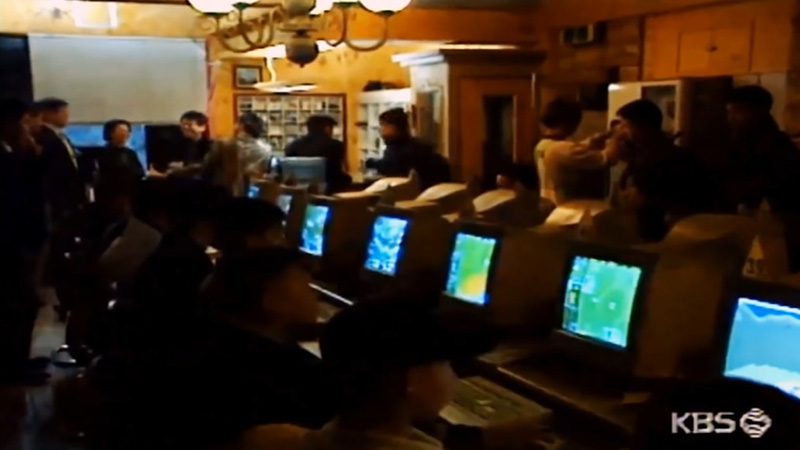
If you want to understand modern Korean gaming culture, you do not start with League of Legends. You start in the late 1990s, in dimly lit PC rooms full of cigarette smoke, cheap snacks, and teenagers clicking at a speed that would eventually change entertainment.
You start with StarCraft.
In most countries, Blizzard’s StarCraft was a successful real-time strategy game. In South Korea, it became something much stranger and much bigger: a mass cultural event, a social infrastructure, a broadcast product, and the foundation stone for modern esports.
StarCraft hit Korea at exactly the right moment
Timing matters more than people admit. StarCraft arrived in a South Korea that was already rapidly wiring itself into the internet age. The original game launched in 1998, and that put it in the middle of a country that was building fast broadband capacity and creating the conditions for networked PC gaming to explode.
That alone would not have guaranteed a cultural takeover. Plenty of games arrive at the right time and still disappear. StarCraft had another advantage: it was extraordinarily watchable, endlessly discussable, and structurally perfect for competitive obsession. Three factions. Constant tension. Strong asymmetry. High skill expression. Easy to grasp badly, hard to master properly.
StarCraft did not merely succeed in Korea. It found a country uniquely prepared to turn a video game into a public institution.
That is why the game’s sales in Korea became so legendary. Background material frequently notes that an enormous share of global StarCraft sales came from South Korea, with Korean sales often cited in the millions and representing a stunning proportion of worldwide demand. That is not just success. That is national-scale fixation.
PC bang culture turned a game into a social habit
The PC bang—Korea’s PC gaming café—was the perfect machine for turning StarCraft from a product into a lifestyle.
For international readers, a PC bang was not just an internet café with games. It was a neighborhood gaming room where people gathered to play, watch, shout, compete, and waste entire evenings very productively. In the late 1990s and early 2000s, these spaces exploded across South Korea.
And StarCraft fit them perfectly.
- It ran well in shared gaming spaces
- It was intensely competitive
- It was social even when played one-on-one
- It rewarded repetition, rivalry, and local bragging rights
This matters because Korea did not only consume StarCraft at home. It consumed it together. That changed everything. The game became part of after-school life, university life, military-barracks nostalgia, workplace small talk, and the broader rhythm of being online in Korea.
You did not just play StarCraft. You lived around it.
StarCraft helped invent the Korean pro gamer
Here is the really important part: StarCraft did not only create players. It helped create the idea of the professional gamer as a recognized social role.
Today, that may sound normal. It wasn’t. Before esports became a global industry, the notion that someone could become a public figure, earn money, train seriously, gain sponsors, and build a career through game competition still sounded bizarre to a lot of people.
Korea made it real faster than almost anywhere else.
Why? Because StarCraft had the right ingredients. It was competitive enough to reward specialization, dramatic enough to broadcast, and popular enough to support an audience. Once television and organized leagues started treating high-level players like real sports performers, the identity of the “pro gamer” stopped sounding ridiculous and started sounding aspirational.
That is one of the biggest things StarCraft gave Korea: not just a game culture, but a career category.

Esports in Korea did not begin with League of Legends
This is one of the great misunderstandings international audiences still make. They know Korea through modern esports stars like Faker, so they assume the esports story begins there.
It doesn’t. Faker belongs to a system that StarCraft helped build first.
The infrastructure of competitive gaming in Korea—teams, coaches, training houses, televised leagues, analysis culture, fandom, sponsorship logic, and the basic idea that gaming skill could be turned into professional spectacle—was forged in the StarCraft era. League of Legends later inherited and expanded that structure. It did not invent it from scratch.
In other words, if Faker became the global face of Korean esports, StarCraft helped build the stage he walked onto.
Korean esports did not begin with Faker. It began when StarCraft convinced an entire country that watching other people play games could be a serious form of entertainment.
Blizzard mattered because Korea mattered to Blizzard
Another interesting part of the story is what StarCraft did for Blizzard itself. The company did not simply sell a hit game in Korea. It found one of the most unusually devoted markets in the world.
That relationship mattered enough that Korea often got symbolic priority in StarCraft-related moves later on, including the exceptional attention around StarCraft: Remastered. Background material repeatedly shows how central Korea remained to the StarCraft story years after the original launch.
This is one reason Blizzard’s name still carries a particular charge in Korea, even after the market moved on in many ways. For a generation of Korean gamers, Blizzard was not just another foreign game company. It was the company behind the game that changed the country’s gaming culture.
Why StarCraft hit so much harder in Korea than elsewhere
There is no single magic explanation, but several forces aligned unusually well:
- Fast internet expansion created the right technical environment
- PC bang culture gave the game social scale
- Competitive intensity matched Korean gaming habits
- Broadcast potential made spectatorship exciting
- Audience size made professionalization commercially viable
You would expect one or two of those factors to be enough for a game to become successful. In Korea, StarCraft had all of them at once.
That is why it became more than a game. It became a national gaming language. People who never touched the title still absorbed the culture around it.
Its legacy is bigger than nostalgia
It is tempting to treat StarCraft as just a golden-age memory—something older Korean gamers talk about with the intensity reserved for their first real obsession. But that undersells its legacy.
StarCraft changed how South Korea thought about gaming, competition, spectatorship, and digital leisure. It helped normalize PC bangs. It helped legitimize esports. It helped create the pro gamer. It helped teach broadcasters and sponsors that gaming could be packaged as serious entertainment. And it helped prepare the cultural ground for every major Korean esports story that came after.
That includes League of Legends. That includes Faker. That includes the whole global image of Korea as an esports superpower.
So yes, StarCraft was “just a game.” But in South Korea, it was also a social technology. It connected rooms, screens, money, fandom, and ambition in a way that changed the country’s digital culture permanently. The real question is not why StarCraft mattered so much in Korea. It is whether any later game has ever again arrived at such a perfect moment to change an entire society’s idea of what gaming could be.
Image Credits: Image from esports.net (editorial use) · Image from malaymail.com (editorial use)


Leave a Reply