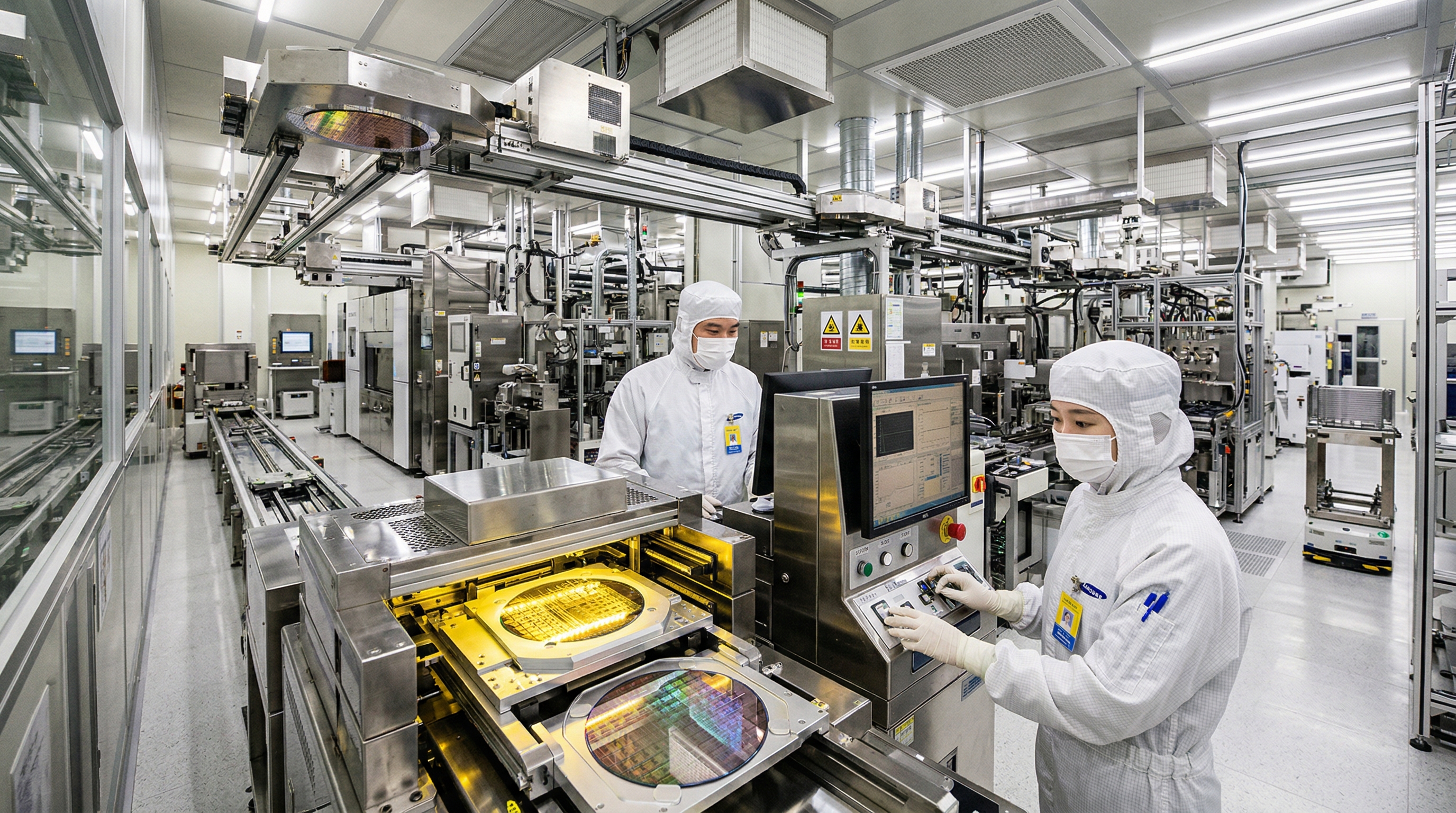
South Korea did not become a semiconductor giant by accident. It became one because the country built the right kind of economy for chipmaking: export-oriented, manufacturing-heavy, technologically ambitious, and willing to pour enormous amounts of capital into industries that take years to reward patience.
That formula now looks obvious. It was not always obvious when the investments were being made.
Semiconductors are one of the most demanding industries in the world. They require money, engineering talent, supply-chain discipline, energy, long-term planning, and the ability to survive brutal market cycles. South Korea developed an unusual capacity to do all of those things at once. That is why the country became especially strong in memory chips, and why two companies — Samsung Electronics and SK hynix — now sit so close to the center of the global industry.
Semiconductors fit Korea’s economic model almost perfectly
South Korea’s broader economic development helps explain the rise of semiconductors. The country spent decades building large export industries in sectors where scale, coordination, and manufacturing quality mattered. Once that industrial base existed, semiconductors became an extension of a national habit: invest hard, manufacture precisely, and compete globally.
There is another structural reason this worked. Korea is geographically compact. That makes concentration easier. A dense industrial geography helps firms cluster talent, suppliers, logistics, and infrastructure in ways that become very powerful in advanced manufacturing. In semiconductors, that kind of concentration matters.
South Korea’s chip strength came from a rare mix of scale, concentration, and patience.
The country also had one more advantage: a strong and growing IT ecosystem. Korea’s rise in electronics, displays, mobile devices, and digital infrastructure created a natural environment in which chip demand, engineering capability, and industrial ambition reinforced one another.
Why Samsung Electronics mattered so much
Any explanation of Korean semiconductors begins with Samsung Electronics. Samsung’s role was not just to compete. It was to normalize very large-scale risk in an industry where smaller commitments often fail. Its long history of aggressive investment in memory chips helped make Korea a serious power long before the world’s current AI-led semiconductor excitement.
Samsung also benefited from something that is easy to say and hard to replicate: it had the balance sheet and industrial confidence to invest before everyone else felt safe doing so. In semiconductors, waiting for certainty can mean arriving too late.
This willingness to invest ahead of the cycle is one reason Korean chip companies have often looked so resilient. They are not simply lucky when the cycle turns upward. They have often spent heavily before the upswing fully arrives.
SK hynix shows that recovery can become dominance
The other pillar is SK hynix, and its story is especially interesting because it did not always look secure. Hynix had periods when it looked weak enough that survival itself became part of the story. That history matters because the company’s current global weight can make people forget it once looked vulnerable.
Its acquisition by the SK Group changed the company’s trajectory. Under SK, Hynix did not just stabilize. It became one of the most important memory players in the world, and in the recent AI memory boom it has looked especially strong in areas like HBM, or high-bandwidth memory.
This matters because the Korean semiconductor story is not simply “Samsung built everything.” It is also a story of how Korea ended up with two heavyweight memory firms, not one. That rivalry helped preserve national scale and sharpen competitiveness.
What the statistics actually show
The reliable big-picture statistics are clear enough even without using every short-term market forecast. According to South Korea’s official e-Nara index service, in 2023 Korea held 13.2 percent of the global semiconductor market overall. More importantly, Korea’s share of the global memory semiconductor market was 61.0 percent, and its share of the global DRAM market was 73.5 percent.
Those are huge numbers. They show why Korea is not just another chip country. It is one of the central countries in memory semiconductors, full stop.
More recent reporting also shows how the Korean story is evolving. AI demand and HBM competition have made the rivalry between Samsung and SK hynix even more important. In some recent quarters, SK hynix even overtook Samsung in global DRAM share, which would have been a remarkable line to read if you only remembered Hynix from its weaker years.
- Global semiconductor market share (Korea, 2023): 13.2%
- Global memory market share (Korea, 2023): 61.0%
- Global DRAM market share (Korea, 2023): 73.5%
Those figures help explain why Korea’s chip industry is treated as strategic not only at home, but globally.
Why long-term investment mattered before the cycle turned
One of the most important parts of the Korean semiconductor story is timing. Korean firms did not simply enjoy favorable conditions once the memory cycle improved and AI demand accelerated. They had already committed vast sums to fabs, equipment, and advanced packaging capacity.
That is especially visible in recent reporting around HBM and next-generation memory. Both Samsung and SK hynix were preparing for a market that had not yet fully rewarded them. When the cycle strengthened, they were not improvising from scratch. They were stepping into capacity they had already been building.
That is the real industrial lesson: success in semiconductors often looks sudden only to outsiders. Inside the industry, it is usually the delayed return on enormous prior spending.
Conclusion
South Korea became a semiconductor powerhouse because its economy was unusually well suited to capital-intensive, export-driven, precision manufacturing. Samsung Electronics built scale early, SK hynix turned recovery into renewed strength, and both companies benefited from Korea’s dense industrial geography, strong IT ecosystem, and willingness to invest ahead of the cycle. That is why Korea’s position in memory and DRAM remains so powerful today. The next question is not whether Korea matters in semiconductors. It is whether any rival can loosen the grip that Samsung and SK hynix built over decades of risk and reinvestment.
Image Credits: AI-generated editorial image · AI-generated editorial image


Leave a Reply