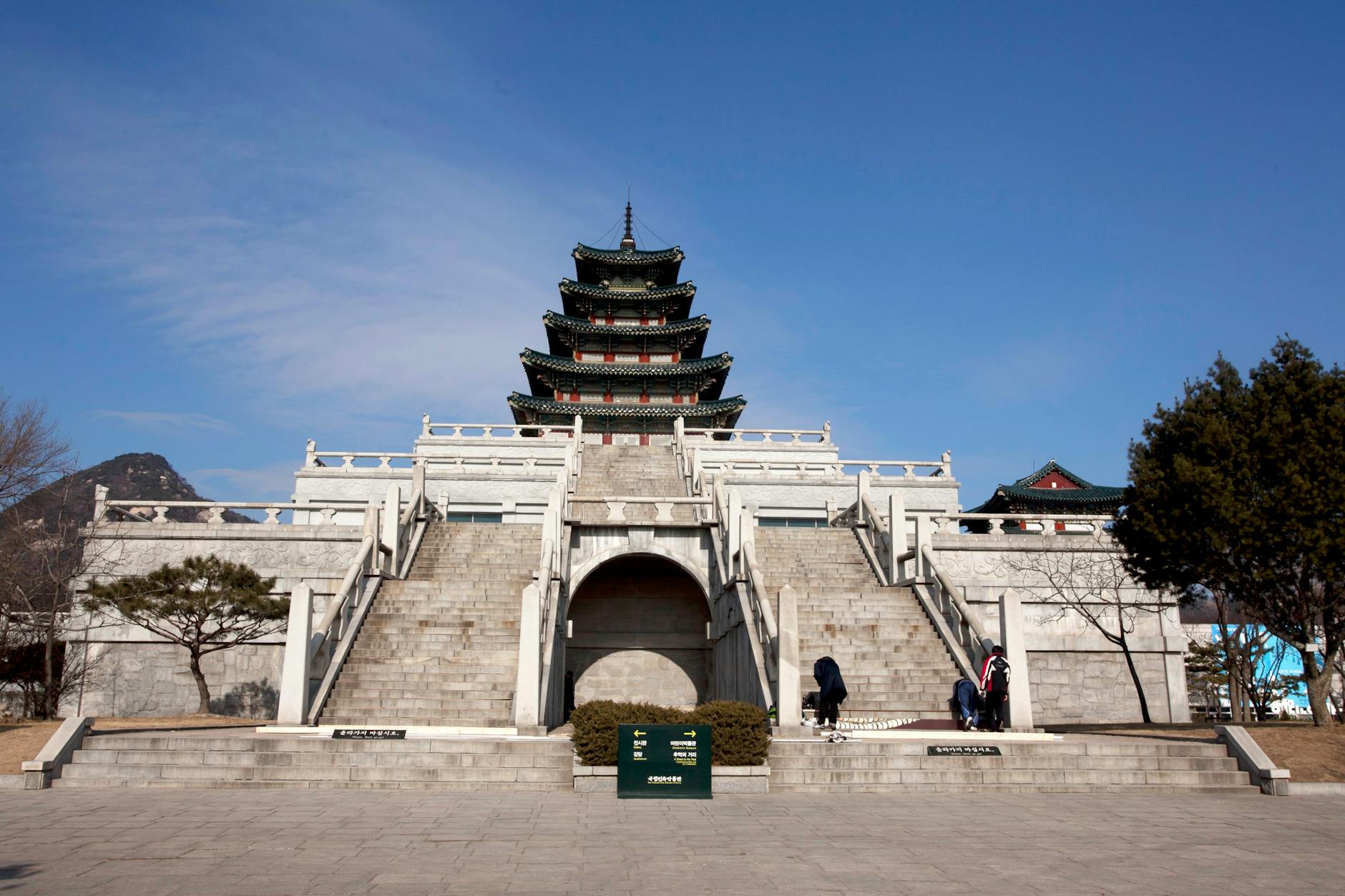
The National Museum of Korea sits at 137 Seobinggo-ro in Yongsan-gu, a short 150-meter walk from Ichon Station Exit 2, and its permanent galleries are free. That also means the cost of entry is unusually low by big-city museum standards, making it one of Seoul’s easiest and best-value major museum visits.
Getting there
The museum is in Yongsan, close to Yongsan Family Park and near the National Hangeul Museum. The official subway directions are simple: take Line 4 or the Gyeongui-Jungang Line to Ichon Station, leave through Exit 2, and walk 150 meters. The underground access route called Museum Nadeulgil runs from 7:00 am to 11:00 pm.
| Item | Details |
|---|---|
| Address | 137 Seobinggo-ro, Yongsan-gu, Seoul, 04383 |
| Subway | Line 4 or Gyeongui-Jungang Line to Ichon Station |
| Walk from station | 150 meters from Exit 2 |
| Opening hours | Mon, Tue, Thu, Fri, Sun: 10:00 am-6:00 pm; Wed, Sat: 10:00 am-9:00 pm |
| Final entry | 5:30 pm on regular days; 8:30 pm on Wed and Sat |
| General admission | Free for permanent exhibitions |
If you want a practical add-on, the National Hangeul Museum is nearby. That matters more than it sounds. You can pair Korea’s broad civilizational story with a focused look at the Korean writing system in one outing.
What is inside
The museum is large, and the gallery structure is unusually clear. On the 3rd floor, the Prehistory and Ancient History Gallery moves from the Paleolithic, Neolithic, and Bronze Age through Gojoseon, Buyeo, Samhan, Goguryeo, Baekje, Silla, Gaya, Unified Silla, and Balhae. The Medieval and Early Modern History Gallery, also on the 3rd floor, covers Goryeo, Joseon, and the Korean Empire.
The same floor also houses the World Art Gallery, with rooms for Mesopotamia, China, Japan, Central Asia, India and Southeast Asia, ancient Greece and Rome, and the Islamic world. That is a useful reminder that the museum is not only inward-looking. It places Korea in a wider Asian and global context.
On the 4th floor, the Calligraphy and Painting Gallery includes Korean painting, Buddhist painting, lacquerware and woodcraft, and the royal records known as the Uigwe, the illustrated protocols of state ceremonies. On the 6th floor, the Sculpture and Crafts Gallery covers celadon, buncheong ware, white porcelain, Buddhist sculpture, metalcraft, and the sensory exhibition space called Space Between.
One of the most memorable parts is not a standard room at all. The central corridor called The Path of History displays the Ten-Story Pagoda from Gyeongcheonsa, a media wall based on the Gwanggaeto Stele, and a reproduction of the Daedongyeojido, Korea’s famous map of the country.
- 3rd floor: Korean prehistory, ancient states, Goryeo, Joseon, Korean Empire, and world cultures
- 4th floor: painting, calligraphy, Buddhist art, lacquerware, and royal records
- 6th floor: ceramics, sculpture, metalcraft, and sensory display spaces
- Extra spaces: Children’s Museum, digital immersive video hall, and reservation-based sensory programs

Why it matters in Seoul
This is not just another large museum in a capital city. It functions as the center of South Korea’s national museum system. The legal framework cited in the source places multiple regional museums under the central museum director, including museums in Gyeongju, Gwangju, Jeonju, Daegu, Buyeo, Gongju, Jinju, Cheongju, Gimhae, Jeju, Chuncheon, Naju, and Iksan.
That administrative role matters because it gives the museum a different weight from a normal city museum. Scholars, students, and specialists visit it regularly for research. It is also the place where major national treasures are concentrated, and that creates both prestige and controversy.
The museum holds National Treasure No. 99, the east and west three-story stone pagodas from Galhangsa Temple in Gimcheon. It also faces return demands from local governments and religious groups over objects that were moved to Seoul, often during the Japanese colonial period. That tension is part of the museum’s real significance. It is a national showcase, but it is also a place where questions of ownership, locality, and cultural centralization do not go away.
The museum is impressive because of what it preserves. It is also revealing because of what it has absorbed from elsewhere.
Why going now makes sense
The museum has had a very current role in the past year. On February 1, 2025, after a fire at the nearby National Hangeul Museum, about 200 important artifacts were urgently moved into the National Museum of Korea’s storage facilities. The source adds that roughly 80,000 collection items from the Hangeul Museum were also scheduled to be transferred over the course of a month for safety.
That episode says something practical about the institution. It is not just a display venue. It is core cultural infrastructure.
There is also recent public-facing activity. Since 2024, the museum has run the National Museum Costume Contest, a heritage-themed cosplay event. On February 26, 2026, President Lee Jae-myung and First Lady Kim Hye-kyung visited the museum and toured major exhibitions, including the special exhibition Our Admiral Yi Sun-sin, while meeting visitors on site.
The museum has also become more visible as a cultural brand beyond the galleries. Recent collaborations mentioned in the source include a museum-edition snack release from Orion, themed goods tied to the museum’s famous contemplation gallery, and a Casetify collection based on major artifacts. Some people will find that commercial. It is. It is also a sign that the museum is trying to operate as a living cultural brand rather than a silent warehouse.
What to expect from a visit
If you go now, expect two things. First, a broad and well-organized survey of Korean history, art, religion, and material culture. Second, a museum that is active in current cultural life rather than frozen behind glass.
Give it at least three to four hours if you want the permanent collection at a reasonable pace. Half a day works better if you add a nearby stop at the National Hangeul Museum area or stay for an evening opening on Wednesday or Saturday. This museum suits first-time visitors to Seoul, repeat travelers who want more than palace grounds, and anyone who wants one place that covers Korean history without feeling superficial. For many travelers, one of its biggest advantages is simple: the admission cost is very affordable, and the permanent exhibition access is effectively one of the best cultural bargains in Seoul.
Image Credits: Photo by Jeffry Surianto on Pexels · User-provided image

Leave a Reply