
People ask this question as if it were a sports matchup. It is not. A war on the Korean Peninsula would be a disaster measured not in points, but in dead civilians, shattered infrastructure, refugee flows, and the risk of escalation far beyond Korea itself.
Still, the question keeps coming up: if South Korea and North Korea fought, who has the military edge? If you strip out the chest-thumping and look at force indicators, the short answer is straightforward. South Korea has the stronger conventional military on paper. The longer answer is where things get serious.
What the rankings say at first glance
According to the Global Firepower 2026 military ranking, South Korea ranks 5th out of 145 countries with a PowerIndex score of 0.1642. In that system, a score closer to zero indicates greater military strength. South Korea has held 5th place for three straight years, behind only the United States, Russia, China, and India.
North Korea ranks 31st. That is an improvement from 34th the previous year. The trajectory is also interesting: North Korea reportedly rose as high as 18th in 2019, then fell to 36th in 2024, before rebounding over the last two years.
That gap matters. A 5th-place military facing a 31st-place military is not a trivial difference. But rankings are only a starting point, not a war outcome simulator.
Military rankings tell you who looks stronger in aggregate. They do not tell you how a war would unfold after the first missile lands.
Why South Korea looks stronger on paper
Global Firepower evaluates more than 60 factors, including manpower, weapons systems, economic capacity, mobilization potential, and defense spending. That framework tends to favor states with a broad, modern, sustainable war-fighting base. South Korea fits that model far better.
Several South Korean strengths stand out from the numbers provided:
- 4,400 towed artillery pieces, ranked 2nd in the world
- 3,270 self-propelled artillery systems, ranked 3rd
- 17 frigates, ranked 3rd
- 3.1 million reservists, ranked 2nd
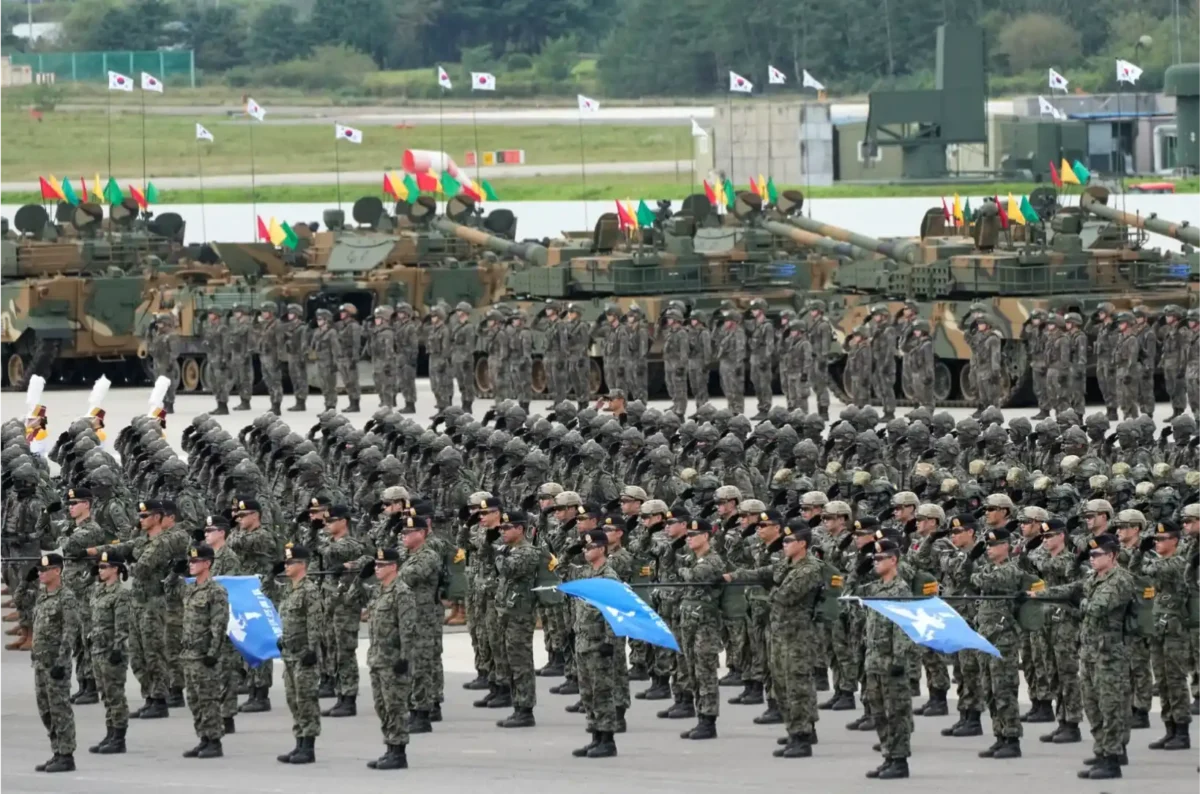
The artillery point is especially important. South Korea’s self-propelled artillery force is considered world-class. That matters because artillery is not glamorous, but in a Korean conflict it would be brutally central. Range, rate of fire, survivability, mobility, and counter-battery capability are the kind of details that decide whether units stay in the fight or get torn apart early.
South Korea also benefits from something raw equipment counts often only partially capture: a more advanced industrial base, stronger economy, and deeper ability to sustain modern military operations over time. Wars burn through fuel, ammunition, spare parts, communications infrastructure, and trained replacements at astonishing speed. Wealth matters. Logistics matter more than people want to admit.
A lot more.

Why North Korea is still dangerous
If this were just a ranking contest, the analysis would end here. But North Korea is not dangerous because it outranks South Korea on paper. It is dangerous because it is heavily militarized, highly centralized, unpredictable, and capable of imposing enormous damage very quickly.
That is the part too many casual discussions miss. A weaker military can still create catastrophic outcomes if it can strike early, absorb losses, and threaten escalation that the other side wants to avoid.
North Korea’s recent rebound from 36th in 2024 to 31st in 2026 does not mean it suddenly overtakes South Korea conventionally. It does suggest that writing it off as irrelevant would be foolish. Even if South Korea holds the overall edge in conventional capability, North Korea retains the capacity to make any conflict staggeringly costly from the opening phase.
This is where a numbers-only conversation starts to crack. A country does not need to be stronger overall to cause devastation.
The most dangerous military is not always the strongest one. Sometimes it is the one most willing to gamble first.
The variables that matter more than ranking charts
If actual conflict ever broke out, the result would depend on far more than headline rankings or artillery totals. Several variables would matter immediately:
- Alliances: South Korea does not operate in a vacuum. External support, especially from the United States, would radically shape the balance.
- Command and control: Decision speed, communications resilience, and the ability to coordinate under attack matter as much as platform counts.
- Logistics: Ammunition supply, maintenance, fuel distribution, and repair capacity decide whether early strength can be sustained.
- Air superiority: The side that controls the air gains a massive advantage in surveillance, strike capability, and survivability.
- Sea control: Maritime access affects reinforcement, trade, missile defense posture, and operational flexibility.
- Initial strike effectiveness: The opening hours could shape the entire conflict.
- Nuclear threat: This changes everything. A conventional comparison is useful, but it does not erase strategic coercion.
- Civilian vulnerability: Dense urban populations near the front make even limited conflict horrifically costly.
This is why the phrase “who would win” is both understandable and misleading. On paper, South Korea likely holds the stronger conventional position. In practice, no serious analyst should treat that as a clean or comforting conclusion.
What a numbers-first view can and cannot tell you
A numbers-first analysis is useful because it strips away some mythology. South Korea’s 5th-place Global Firepower ranking, 0.1642 score, and major strengths in artillery, naval assets, reserves, and broader state capacity all point in the same direction: South Korea has the superior conventional military base.
North Korea’s 31st-place ranking does not erase that gap. But its rebound from recent lows is a reminder that military relevance is not static. More importantly, its threat profile has never depended on winning a clean conventional comparison. It depends on deterrence, disruption, escalation risk, and the ability to impose unbearable costs.
So yes, if the question is narrowly about conventional military indicators, South Korea has the edge. Fairly clearly.
But that should not reassure anyone too much. On the Korean Peninsula, the real horror is that even the “stronger” side could face a war so destructive that the word victory starts to sound naive. The smarter question is not who wins. It is how the region avoids finding out.
Image Credits: Image by jeremy888 on Pixabay · Image by StillWZ on Pixabay



Leave a Reply