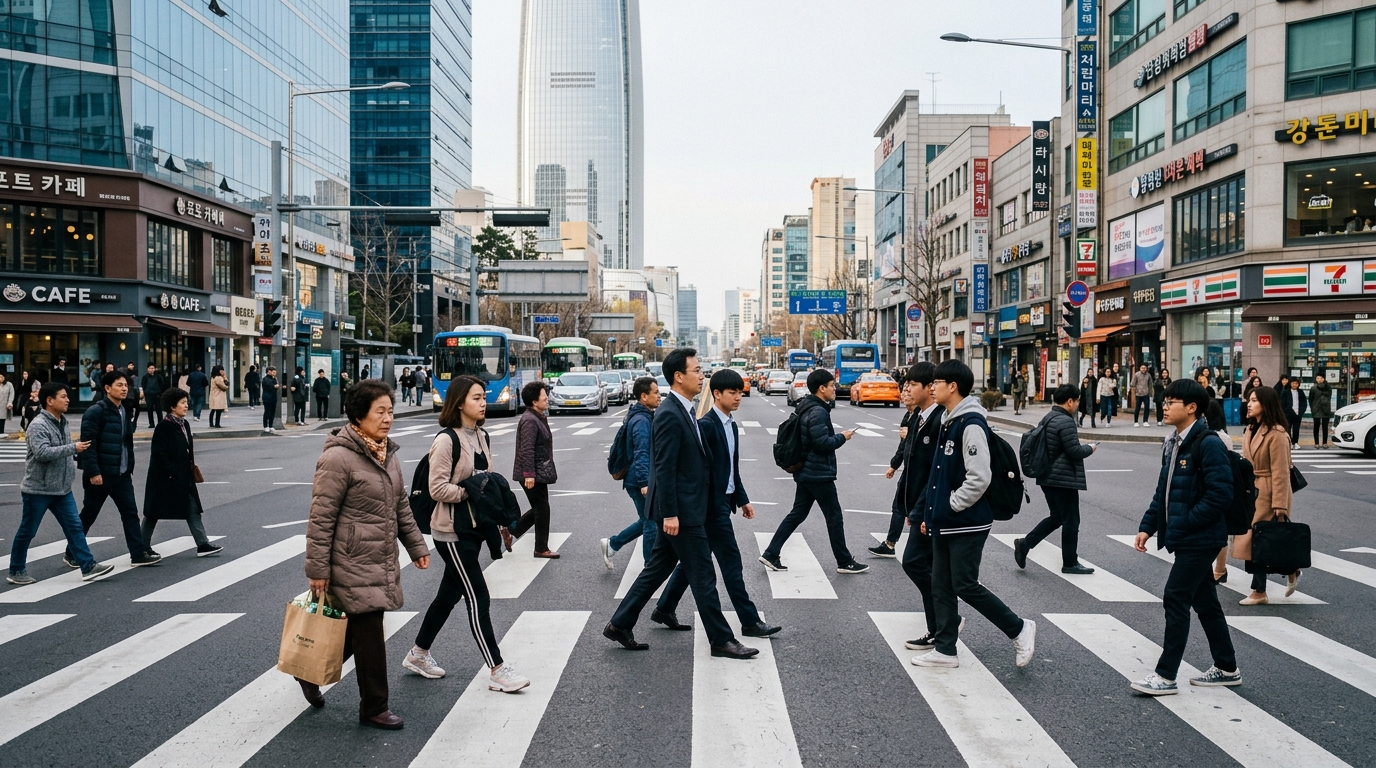
Trying to explain who Koreans are with one neat sentence is where most foreign explanations go wrong.
The easy version sounds simple enough: Koreans are the people of Korea, they speak Korean, and they share a long historical background on the Korean Peninsula. That is not false. It is just far too thin to explain modern reality.
Today, “Korean” can refer to ethnicity, citizenship, language, cultural belonging, or some combination of all four. It can describe people in South Korea, people in North Korea, and diaspora communities whose lives were shaped in the United States, Japan, China, Central Asia, and elsewhere. The word sounds singular. The lived reality is not.
If international readers want a more useful answer, the better question is not simply Who are Koreans? It is How did Korean identity come to mean what it means now?
Korean identity is historical, but it is not frozen
Korea is often introduced as an old civilization with a strong sense of continuity, and there is truth in that. The Korean language, long historical memory, shared cultural references, and a strong sense of civilizational inheritance still matter. Many Koreans continue to see identity through those long historical lines.
But modern Korean identity was not handed down untouched from the past. It was reshaped by colonization, war, division, industrialization, democratization, migration, and globalization. Those forces did not just change politics or economics. They changed how Koreans imagined themselves.
This is why broad foreign descriptions often feel inadequate. Korea is not only ancient, and it is not only modern. Korean identity is built from both memory and acceleration. It carries an unusually compressed history of trauma, development, and reinvention.
To understand Koreans, you have to understand that continuity matters in Korea, but so does rupture.
Ethnicity, citizenship, and language overlap — but not perfectly
One reason the subject gets confusing is that many people outside Korea treat ethnicity and nationality as if they automatically match. In Korea, they often overlap, but not completely.
Someone can be ethnically Korean without holding South Korean citizenship. Someone can be a citizen of South Korea and still feel distant from older ethnic ideas. Someone can have Korean ancestry but speak little Korean. Someone else can speak Korean fluently while growing up outside the peninsula. All of these people may still, in different ways, belong under the label “Korean.”
Language remains one of the strongest anchors of Korean identity. Korean is not just a tool for communication. It carries hierarchy, intimacy, age differences, humor, emotional restraint, and social nuance. But language alone is not a perfect border. Diaspora life made sure of that long ago.
That is why the most honest definition is a layered one. Korean identity is shaped by shared historical roots, but it is lived through different passports, different local histories, and different degrees of linguistic and cultural closeness.
- Ethnicity still matters strongly in many Korean self-understandings.
- Citizenship matters in legal and political life, especially in South Korea.
- Language is a major cultural marker, but it does not decide everything on its own.
- Diaspora experience means Korean identity can persist even when geography changes.
The division of Korea changed the meaning of being Korean
No explanation of Korean identity is complete without the division of the peninsula.
Outside Korea, people often imagine Koreans as one people split between two states. Historically, that idea makes sense. But in practice, decades of separation created two deeply different political systems, public cultures, educational narratives, and social realities. South Koreans and North Koreans still share historical roots, but they do not live the same modern identity.
This is one of the most important points for international readers. Korea’s division is not just a border problem. It is an identity problem as well. The idea of shared peoplehood still carries emotional weight, yet everyday life in the North and South has been shaped by radically different institutions for generations.
So when people say “Koreans,” the term can still imply common origin. But it can no longer imply a single contemporary experience. That distinction matters.
Diaspora Koreans are not a footnote
Another common mistake is treating overseas Koreans as peripheral to the story. They are not.
Korean communities outside the peninsula have their own long and sometimes painful histories. Korean Americans, Zainichi Koreans in Japan, ethnic Koreans in China, and Koryo-saram communities in Central Asia are not all versions of the same experience. Each group was shaped by migration, empire, discrimination, adaptation, and local history in different ways.
Some maintain strong Korean-language ability across generations. Others hold onto identity through food, family memory, church life, surname, ritual, or inherited community ties even when language weakens. That does not make them less real. It makes Korean identity larger than the peninsula itself.
In other words, “Korean” is not only a homeland identity. It is also a diasporic identity with multiple centers of memory.

Modern Koreans live between pressure, pride, and rapid change
International audiences often meet Korea first through polished exports: K-pop, K-dramas, beauty culture, food, fashion, or technology. Those are real parts of modern Korea, but they do not explain Korean life by themselves.
Modern South Korea is urban, highly connected, competitive, image-conscious, and intensely shaped by speed. It is also a society marked by memory, hierarchy, family expectation, educational pressure, and generational disagreement. Older Koreans may carry memories linked to war, poverty, authoritarian development, or national rebuilding. Younger Koreans have grown up in a democracy defined more by digital life, housing stress, work fatigue, gender conflict, and global cultural visibility.
That generational gap matters because it changes how people think about success, duty, nationalism, relationships, and belonging. A modern Korean identity is not simply traditional or simply cosmopolitan. It is often both at once, and sometimes awkwardly so.
This is why clichés about “ancient tradition meeting the future” feel too clean. Korea is not split between old and new. It lives inside both, at the same time.
What foreign readers often misunderstand
Several misconceptions show up again and again.
Koreans are not socially identical
Korea is often described as relatively homogeneous, but that does not mean Korean society is simple. Region, class, generation, religion, education, political outlook, and global exposure all shape how people live and what they believe.
Korean identity is bigger than Hallyu
The Korean Wave has helped global audiences notice Korea, but it is still only one gateway into a much larger reality. Popular culture can introduce Korea beautifully, but it cannot carry the whole explanation.
Pride and criticism coexist
Many Koreans feel strong pride in Korean language, history, cultural visibility, and economic achievement. Many are also sharply critical of Korean society. These two instincts are not contradictory. In Korea, they often live side by side.
The biggest mistake is looking for one “Korean personality.” Korea makes more sense when you look at its recurring tensions instead.
So who are Koreans?
Koreans are a people connected by language, history, and long cultural memory, but they are not defined by a single modern experience. They include South Koreans, North Koreans, and diaspora communities whose relationships to Korea vary widely. They are shaped by continuity, but also by colonialism, war, division, migration, industrialization, and globalization.
That may sound less tidy than the usual stereotype. Good. It is also more accurate.
If international readers want to understand Koreans better, the most useful starting point is to stop looking for a fixed essence. Korean identity is not one timeless thing hiding beneath history. It is something history keeps reshaping.
And that is exactly what makes it worth understanding.
Image Credits: AI-generated image · AI-generated image
Leave a Reply