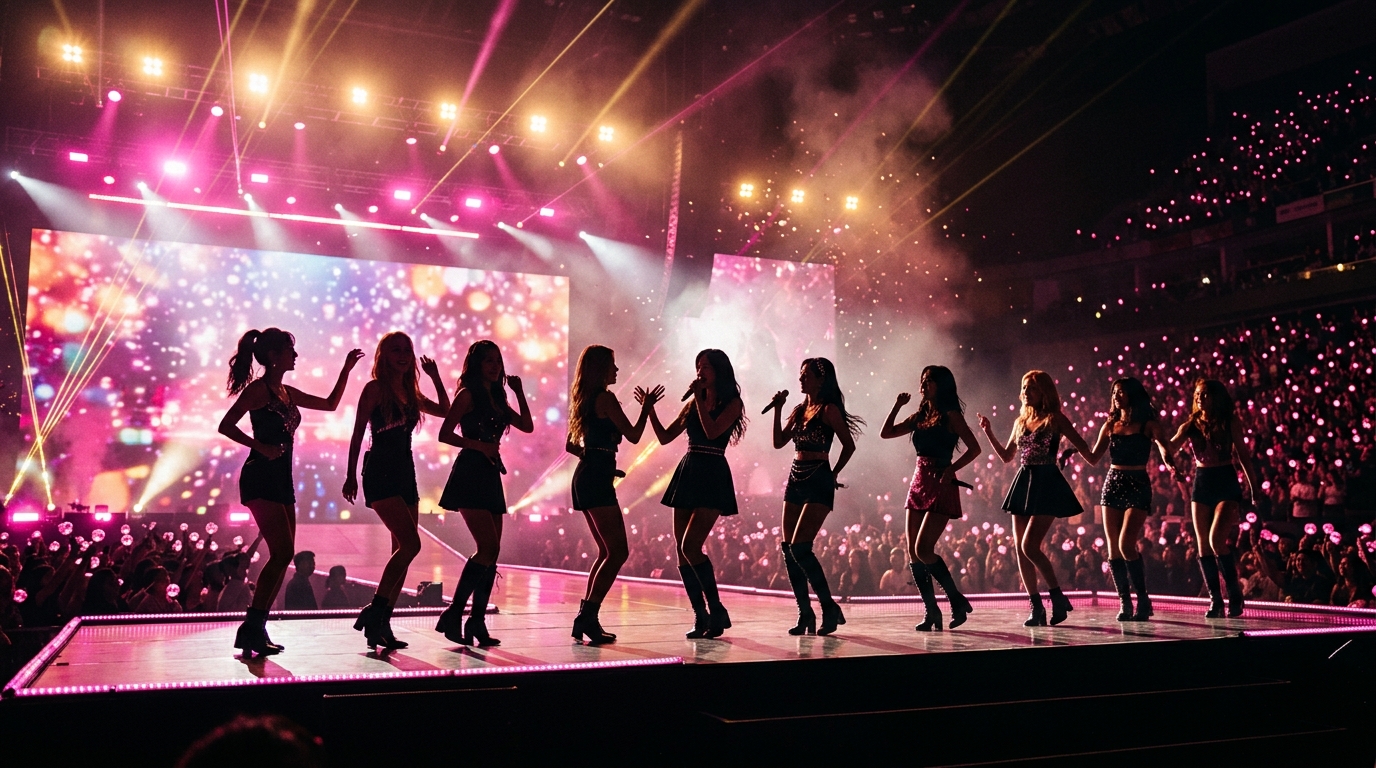
Some groups are remembered because they had hit songs. Girls’ Generation are remembered because they changed the size of the room.
When people talk about second-generation K-pop, this is one of the first names that comes up, and not by accident. Girls’ Generation debuted in 2007, and they came to represent a moment when K-pop girl groups stopped being a niche youth obsession and became something much larger: mainstream, cross-generational, culturally dominant, and exportable.
That matters. A lot.
The most useful way to understand Girls’ Generation is not as a list of comebacks or a nostalgia object for older fans. It is to see them as one of the groups that helped define what a top-tier K-pop girl group could be: musically versatile, visually recognizable, personality-driven, commercially durable, and strong enough to shape the industry around them.
They debuted in 2007, but their significance was bigger than timing
Girls’ Generation debuted in 2007, right as K-pop was entering the phase now commonly described as the second generation. That era pushed the idol system into a more ambitious form: tighter training, stronger branding, bigger fandom culture, more polished performance, and much more aggressive expansion beyond Korea.
Girls’ Generation became one of the defining faces of that shift. Critic Lim Jin-mo described them as the key players in K-pop globalization who expanded idol music, once considered the exclusive property of younger generations, to all age groups. That is not small praise. It gets at the reason they still matter. They did not simply attract fans. They broadened the social reach of the idol format itself.
Another critic, Mimyo, argued that Girls’ Generation played a major role in creating the moment when the American pop market began paying attention to K-pop. Before that, K-pop had often been in the position of importing songs and trends from abroad. Girls’ Generation helped show that Korean acts could also be artists that major overseas producers would take seriously.
So yes, they were stars. But they were also a signal. K-pop was no longer content to remain local in ambition.
Girls’ Generation did not just succeed inside the system. They helped prove the system could scale.
Why the nine-member lineup worked so well
Part of Girls’ Generation’s power came from structure. A nine-member group can be messy if the lineup feels crowded or redundant. This one did not. It felt engineered for range.
The teaser rollout at debut introduced the members in this order: Yoona, Tiffany, Yuri, Hyoyeon, Sooyoung, Seohyun, Taeyeon, Jessica, and Sunny. That sequence alone tells you something about the way the group was presented: not as an anonymous unit, but as a team of distinct faces, tones, and functions.
The source material divides their official positions into a vocal line and a dance line. The vocal line consisted of Taeyeon as main vocalist and Tiffany, Sunny, and Seohyun as lead vocalists. The dance line featured Hyoyeon and Yuri as main dancers and Sooyoung and Yoona as lead dancers. There was no official rapper position, though Hyoyeon and Tiffany often handled rap parts, with Yuri and Sooyoung taking them depending on the song.
That matters because Girls’ Generation were not built around one obvious center doing everything while the rest filled space. The team had specialization. More importantly, it had recognizable excellence in different lanes. The source explicitly notes that each member became representative in her field, naming Taeyeon in vocals, Hyoyeon in dance, and Yoona as the best-known center and visual.
That kind of internal balance is one reason the group felt so large in the public imagination. Fans could attach themselves to very different strengths without the group losing coherence.
They outlived the old rule that girl groups peak fast and fade
There is a line in the source material that says a lot about Girls’ Generation’s place in K-pop history. A 2019 piece in Semteo referred to the old industry saying about a “three-year life cycle” for girl groups: roughly one year to break through, then two concept changes over the next two years, after which popularity naturally starts fading.
And then came the crucial point. The piece says that Girls’ Generation were essentially the only girl group that maintained absolute top-tier peak status even after that three-year threshold.
That is not just a compliment. It is an industry-level statement. They did something that many groups were not expected to do: remain dominant long enough to outgrow the normal shelf-life logic attached to girl groups. In K-pop, longevity is power. Female idol longevity, especially at the very top, has historically been even harder. Girls’ Generation broke that pattern so clearly that the exception became part of their legend.
You can feel the effect of that even now. Later girl groups did not have to invent the idea that a girl group could command long-term cultural authority from scratch. Girls’ Generation had already kicked the door open.

They were not just famous. They became symbolic
Some groups are popular. Some become shorthand. Girls’ Generation became shorthand.
They came to symbolize a certain scale of girl-group success in the second generation: hit-making visibility, broad public familiarity, strong member branding, and a sense that the group represented more than the sum of its songs. Their importance was not only musical. It was structural.
That is why they are so often described as representative of an era. They helped define what the second-generation girl-group peak looked like. Big lineup. Strong individual member identities. Performance polish. Media presence. Broad public reach. A fandom strong enough to matter, but with appeal beyond fandom too.
That last point is critical. Plenty of groups have loyal fans. Fewer become part of general public memory. Girls’ Generation did both.
- Debut year: 2007
- Era represented: second-generation K-pop
- Historical role: helped expand idol music beyond a youth-only audience
- Industry significance: one of the groups tied to K-pop’s globalization push
- Durability: outlasted the old “three-year life cycle” expectation for girl groups
The members mattered as individuals, not just as a brand
One reason Girls’ Generation lasted so powerfully in public memory is that the members were never presented as interchangeable. The source material is full of pairings, combinations, and internal chemistry: Taeyeon and Tiffany as a famously close duo who often sang together, Taeyeon and Yoona as a pairing so stacked with star power it felt almost unfair, Sooyoung and Sunny as a height-contrast comedy pairing, Yuri and Sooyoung as high-energy variety chaos, Hyoyeon and Seohyun as an unlikely but durable combination.
At first glance, that kind of detail can look like fan trivia. It is not. It is evidence of how fully the group functioned as a social universe. Fans were not just consuming singles. They were reading personalities, friendships, inside jokes, chemistry, and role distribution. That became one of the great engines of K-pop fandom culture more broadly.
The source also makes a broader point: each member became a representative figure in her own field. That is the bridge between past and present. Even when people are no longer discussing the group only as a single active unit, they still read Girls’ Generation through the individual strengths the lineup made famous in the first place.
The smartest thing about Girls’ Generation was that the group felt massive without feeling faceless.
Why they still matter now
If you are an international K-pop fan trying to understand why Girls’ Generation are treated with such automatic respect, here is the cleanest answer: they were one of the groups that turned the idea of a K-pop girl group into something culturally central, commercially durable, and globally legible.
They debuted in 2007. They came to embody the second generation. Critics cited them as major players in K-pop globalization and as an important reason idol music expanded beyond a youth market. They were also singled out as a rare girl group that stayed at the absolute top beyond the so-called three-year peak window.
That is already enough to make them important. Add the member structure, the clear division of strengths, the strong individual identities, and the scale of their symbolism, and the picture becomes obvious. Girls’ Generation were not just one successful team among many. They were one of the reference points by which later girl groups would be judged.
And that is why they still feel current even when the era that made them famous is no longer current at all. Some acts belong to their time. Girls’ Generation helped define theirs so completely that K-pop still has to speak in relation to it.
That is what legends look like in pop music. Not just fame. A lasting standard.
Image Credits: AI-generated image · AI-generated image



Leave a Reply